

From FIU labs to top neurotech startups: Triple alum a force in Silicon Valley
For Sebastian Marquez, biomedical engineering represents the perfect convergence of two worlds that he is passionate about: the innovation and precision of technology and the human impact of medicine. It is this intersection that defined his academic journey at FIU and has propelled him to remarkable success in his career.
“My dad gave me advice that has helped shape every career decision I’ve made,” Marquez says. “He told me to choose something I’d love so much that I’d do it for free, because in doing so I would become exceptional at it and people would compensate me well. So I always ask myself three questions: Will this work give me satisfaction? Is it challenging? And will it help others?”
Today, Marquez is new product development manager at Silicon Valley-based Ceribell. There, he is leading next-generation hardware development at the forefront of a breakthrough in emergency neurological care: an AI-powered point-of-care EEG system that rapidly detects, diagnoses and monitors seizures.
Before joining Ceribell, Marquez was an early employee at Alto Neuroscience, a biopharmaceutical startup that, like Ceribell, has recently gone public. While Alto applies brain-based biomarkers to develop precision medicines for mental health, Ceribell operates in the medical device space, building next-generation systems for real-time neurological monitoring. The contrast between the two industries, biopharma and medtech, reflects his continued pursuit of innovation and learning across the evolving landscape of brain science.
It's the kind of innovation that would have seemed impossible to the young immigrant born in Medellín, Colombia, who spoke only Spanish and fled as a political refugee at age 12 with his parents and older brother. The family settled in Miami and later Orlando.
Although he always had a technical mind and thought he might be interested in engineering, Marquez began college at the University of Central Florida as a biology major. When his father suggested he explore the relatively new field of biomedical engineering, the suggestion proved transformative. Marquez transferred to FIU, where its established program was already earning accolades.
Marquez earned a bachelor’s in biomedical engineering (2016), a master’s in electrical engineering (2017) and a Ph.D. in electrical and computer engineering (2020) from FIU’s College of Engineering & Computing.

His classroom education at FIU and his involvement in organizations such as the Biomedical Engineering Society, Institute of Electrical and Electronics Engineers, Engineering in Medicine and Research Initiative for Scientific Enhancement were equally vital to his development.
Also crucial was the access he had to FIU’s engineering faculty and their research labs, where curiosity was met with exceptional mentorship and opportunity. During his undergraduate years, Marquez worked across three research groups: the Medical Photonics Laboratory led by Jessica Ramella-Roman; the Human Cyber-Physical Systems (HCPS) Laboratory headed by Ou Bai; and the Adaptive Neural Systems Laboratory.
“These experiences were among the most valuable aspects of my time at FIU,” he says. “They not only provided hands-on technical training, but also fostered a love for research, exploration and collaboration.”
He urges today’s students to pursue similar opportunities.
“Go talk to people. Don’t be afraid to ask to work in a lab. You only need one person to say yes.”
He’s particularly grateful for the experiences in the HCPS Laboratory with Bai, his mentor and doctoral advisor. There, he worked on multiple projects, including sensor development to diagnose leg-length discrepancies and identification of biomarkers indicative of Parkinson’s disease.
“By the time I graduated, I had authored or co-authored 16 publications, received a patent and was working on commercializing our technology for Parkinson’s disease,” he says.
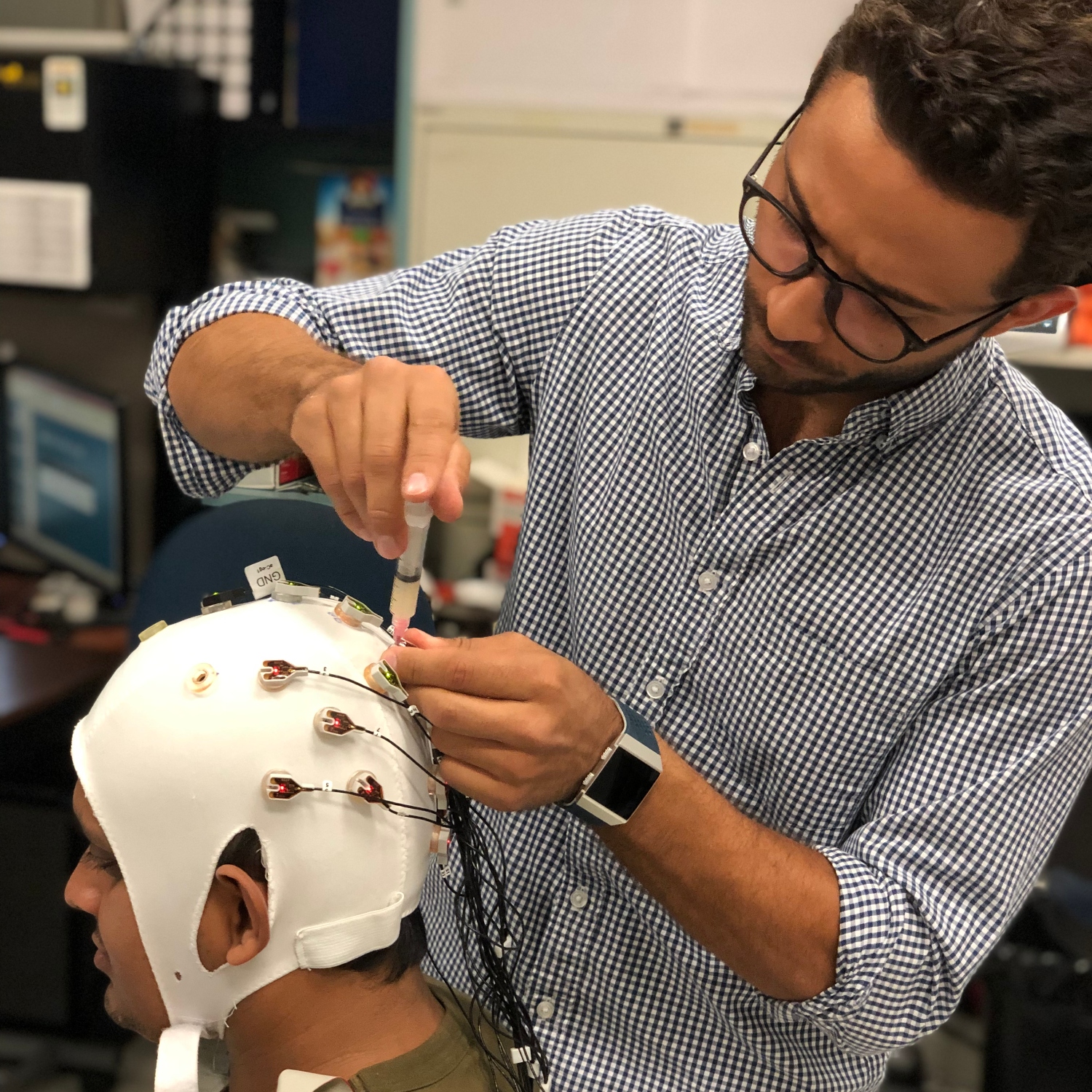
Marquez conducts a motor imagery experiment on S M Shafiul Hasan MS '21, Ph.D.'22. Using EEG technology developed at the Human Cyber Physical Systems Lab under Professor Ou Bai, they demonstrated that brain signals recorded up to one second before movement can predict intentions to start or stop walking with approximately 76% and 74% accuracy, respectively. The study, "Prediction of Gait Intention from Pre-movement EEG Signals: A Feasibility Study," revealed the potential for more natural and responsive brain-computer interfaces in prosthetics and exoskeletons.
“Sebastian was an outstanding student,” Bai says. “We provide opportunities, but he was always eager to learn. He is a great forward-thinking leader who inspires his colleagues and is a problem-solver.”
Those qualities became increasingly important as Marquez worked with university staff charged with helping move products from the research phase to the market by collaborating with industry partners.
“From the earliest days of working with Sebastian at FIU, he knew that he wanted to advance from researcher to inventor and then on to entrepreneur,” says Robert Hacker, director and co-founder of StartUP FIU. Hacker became an influential mentor to Marquez, teaching him business acumen and details such as the importance of user feedback.
“Joining a startup in Silicon Valley after his Ph.D. was just the next logical step in his plan, but he intentionally chose to be challenged in the best startup community in the world,” Hacker says.
While Marquez continues to push boundaries professionally, he also finds time to give back. He mentors young students interested in STEM and, in his downtime, enjoys restoring vintage cars. An engineer to the core.
