
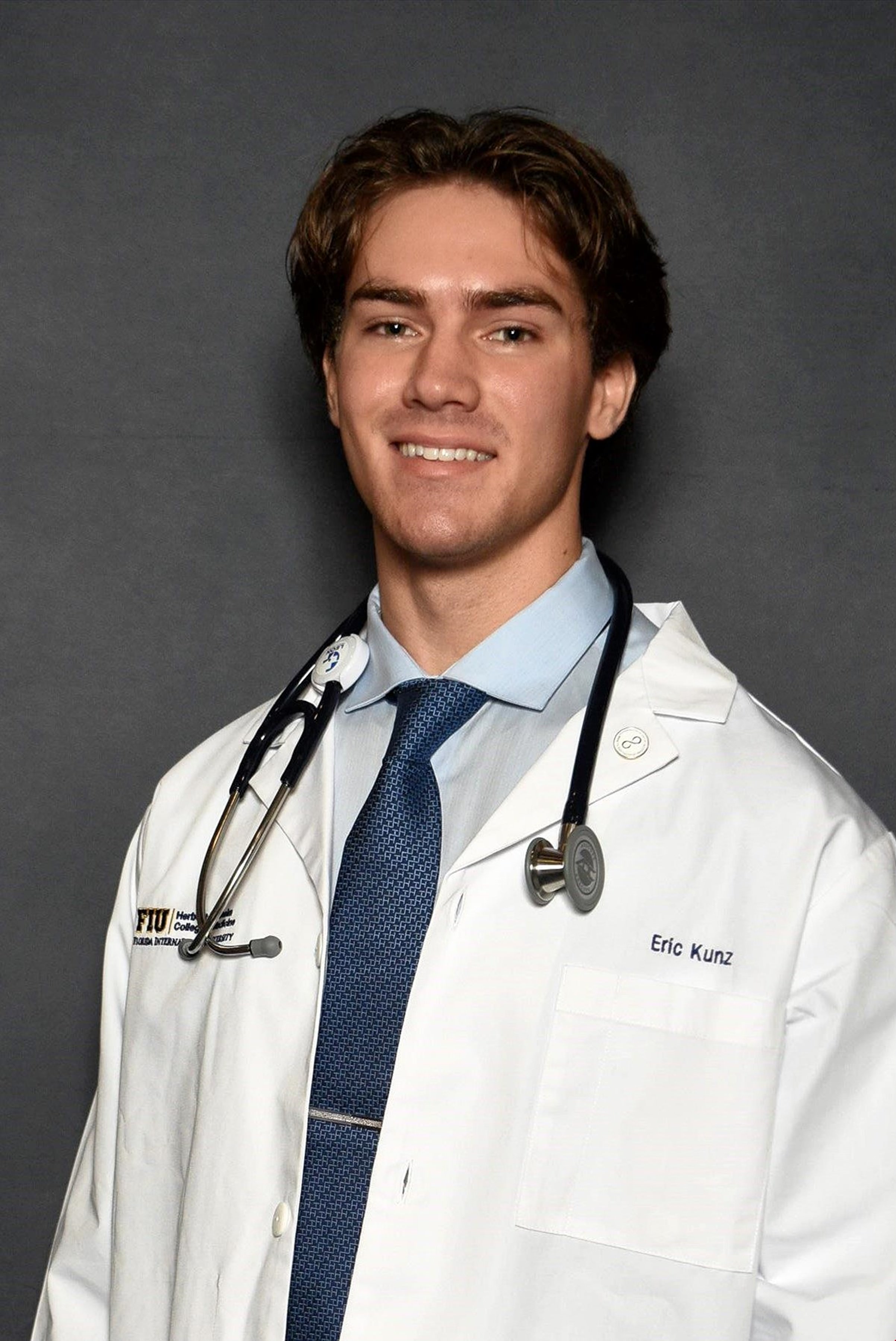
Third-year medical student Eric Kunz didn’t always plan on becoming a doctor. But looking at the work he’s doing now, it’s clear he chose the right path.
At FIU Herbert Wertheim College of Medicine (FIU Medicine), Kunz has quickly built a reputation as a student researcher focused on helping physicians better understand and treat complex neurological conditions.
His work has already earned national recognition and is beginning to shape how clinicians think about brain hemorrhages and tumor-related changes.
Rethinking how brain bleeds are treated
One of Kunz’s research projects focuses on improving treatment for chronic subdural hematomas, a type of brain bleed that develops gradually after a fall or head injury. Blood collects between the brain and its outer layers, creating pressure that can become life-threatening if left untreated.
About 125,000 subdural hematomas are diagnosed each year in the U.S. and are a growing issue, especially among older adults. While surgery is effective at removing the blood, the condition returns in about 15% to 20% of patients.
Kunz has been studying a newer, less invasive approach known as middle meningeal artery embolization. Instead of opening the skull, physicians thread a catheter through an artery and block the blood supply feeding the hematoma. In some cases, it can replace surgery altogether; in others, it’s used alongside surgery to reduce the risk that the bleed will come back.
“When added as an adjunctive procedure, subdural hematoma recurrence rates have been reported to drop below 10%,” said Kunz, noting that patients may also experience a faster and easier recovery.
His work looks closely at which patients benefit most from the procedure, either as a standalone treatment or in combination with surgery. The study focuses on groups that haven’t been studied in depth, including older adults, patients with dementia and those with larger hematomas.
The project earned Kunz the 2026 Carolyn L. Kuckein Student Research Fellowship, awarded by the Alpha Omega Alpha (AΩA) Honor Medical Society. It is one of the nation’s most competitive honors for medical student researchers.
“It means the world to me,” he said. “Positive feedback in medical research and training often takes time, so it was rewarding to receive that kind of encouragement.”
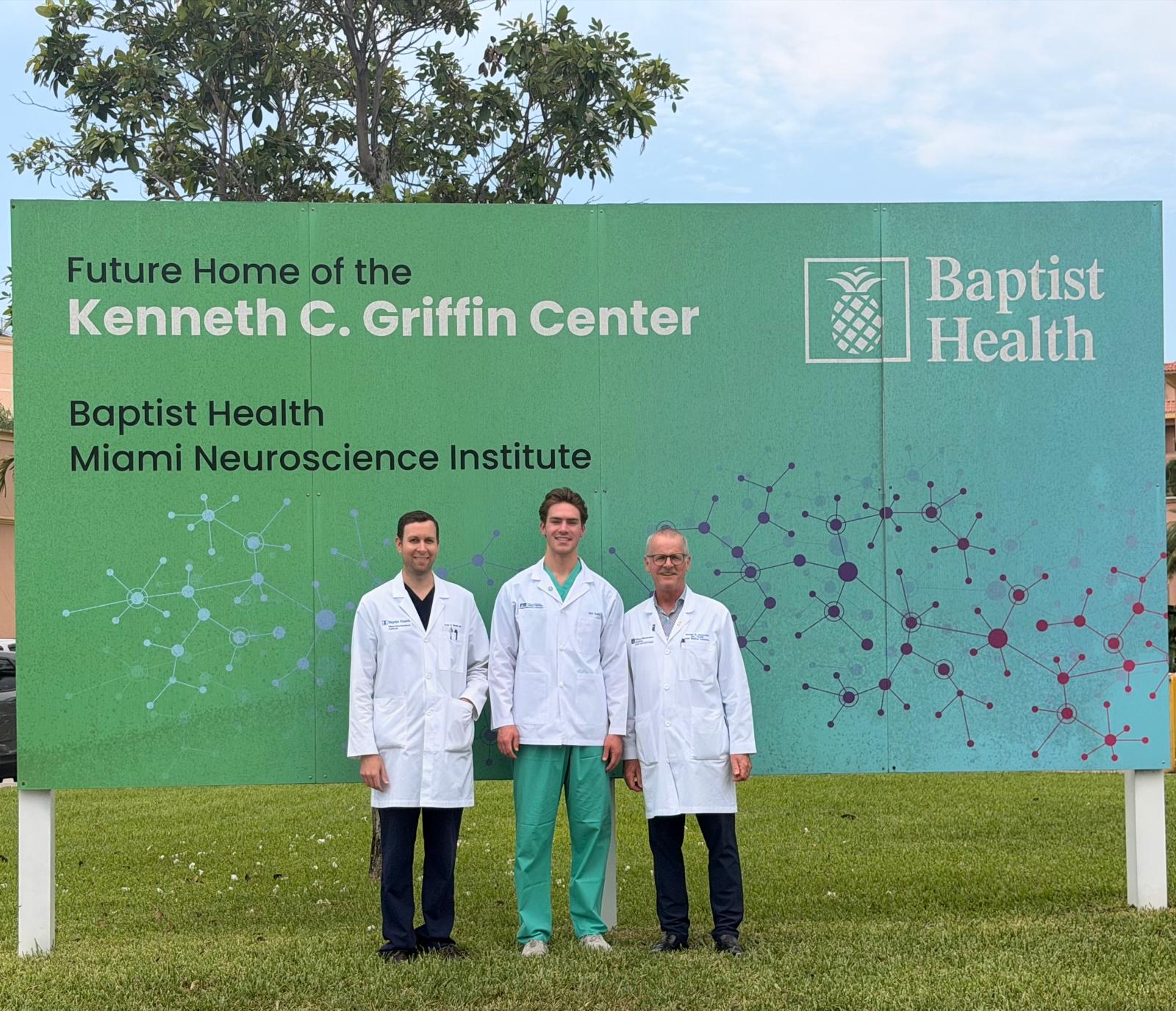
Supported by the fellowship, Kunz is working on the project with Dr. Robert Wicks, principal investigator, associate professor at FIU Medicine, co-director of cerebrovascular surgery and director of the Neuroendovascular Surgery Fellowship at Baptist Health Miami Neuroscience Institute, to generate better data and help physicians make more informed decisions at the bedside. He is also mentored by Dr. Michael McDermott, chair of the Department of Neurosciences at FIU Medicine, system chief executive of Baptist Health Brain & Spine Care, and chief medical executive at Baptist Health Miami Neuroscience Institute.
“This project allows us to communicate our own results, not someone else’s, to patients during the informed consent process while also helping identify opportunities for improvement,” said McDermott.
Kunz has already presented preliminary findings at the American Association of Neurological Surgeons Annual Meeting, with additional presentations planned this year.
Mapping how tumors reshape the brain
Kunz has also been recognized for his research in connectomics, the study of how different regions of the brain communicate.
The research focuses on anterior skull base tumors, which form near the front of the brain and can subtly change how brain networks function. Kunz is using advanced brain-mapping technology to examine how these tumors disrupt connectivity across different regions of the brain and what that might mean for both surgery and recovery.
His work earned him the Emerging Innovator Award from Omniscient Neurotechnology, a global medical technology company that develops FDA-cleared, AI-powered brain-mapping tools to help neurosurgeons better understand complex neurological conditions.
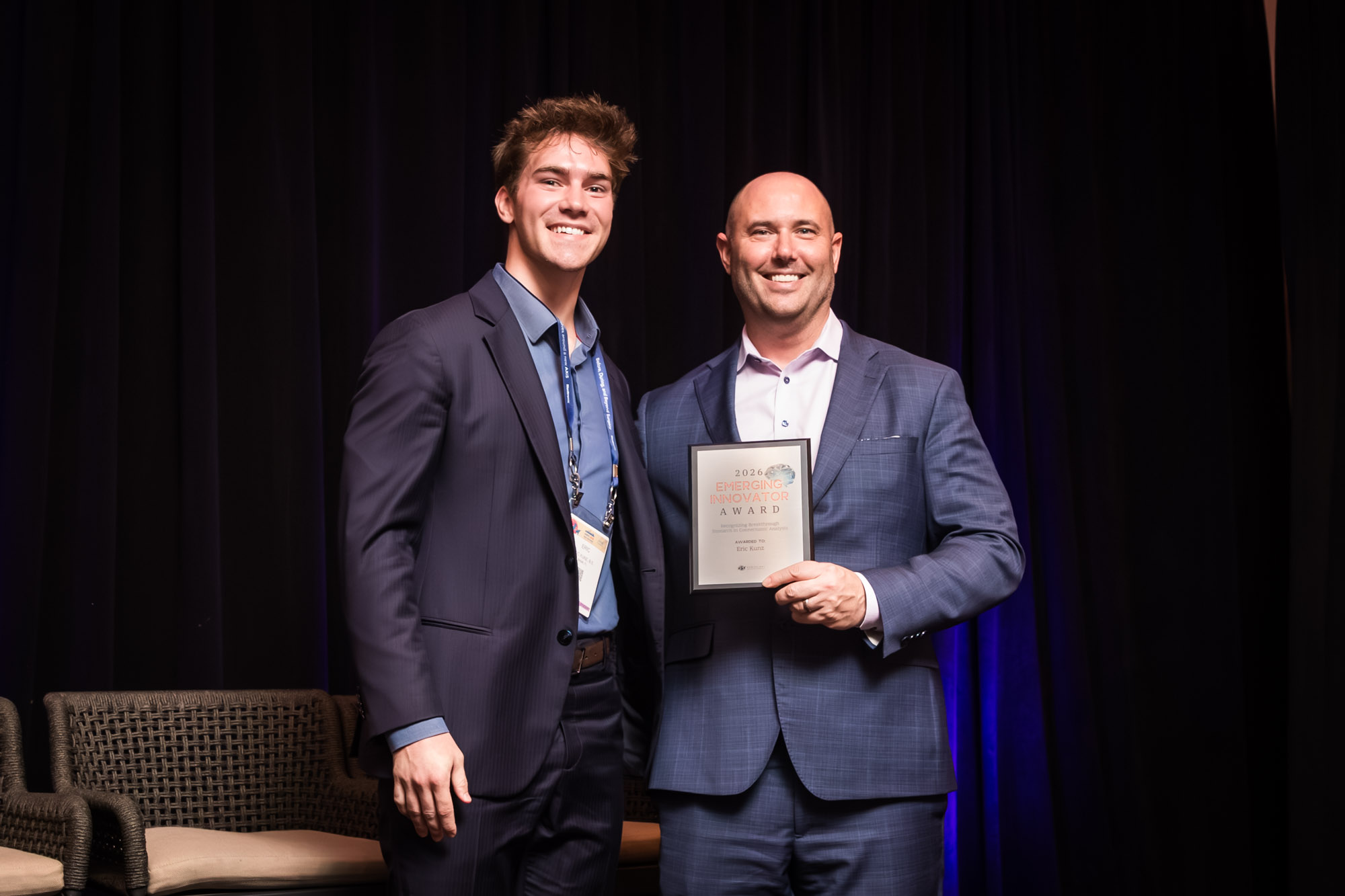
Eric Kunz (left) receives the 2026 Emerging Innovator Award at the Connectomics Circle Summit during the American Association of Neurological Surgeons Annual Meeting in San Antonio. Pictured with Peter Fecci, M.D., Ph.D., the summit’s master of ceremonies.
“It was an absolute honor,” said Kunz, the only medical student recognized alongside neurosurgery residents. “I was incredibly grateful to be recognized in a similar manner.”
Kunz is collaborating with McDermott and Dr. Evan Bander, director of endoscopic skull base surgery and co-director of the pituitary tumor program at Baptist Health Miami Neuroscience Institute, on a study titled “Connectomic Changes Secondary to Anterior Skull Base Tumors.”
The project is still in its early stages, but it could have wide-reaching implications.
“Large tumors in the anterior and middle skull base can cause changes in personality and behavior that often resolve after tumor removal,” said McDermott. “This research may help us predict which changes patients or their families notice are temporary.”
A better understanding of how tumors alter brain networks could also help surgeons plan procedures more effectively and predict what patients might experience before and after surgery. It may also shed light on other conditions tied to disrupted brain connectivity, including Alzheimer’s disease, epilepsy and schizophrenia.
Kunz will present his findings at the Congress of Neurological Surgeons Annual Meeting this fall.
A path shaped by personal experience
Kunz originally planned a career in investment banking but reconsidered after a basketball knee injury that required surgery. While recovering, he became curious about the science behind healing and rehabilitation.
His interest deepened during his undergraduate years at the University of Florida, where he worked in a molecular biology lab and as an emergency medical technician. One call especially stuck with him: he performed CPR on a child with a neurological condition who died shortly after arriving at the hospital.
“It wasn’t long after that I had inwardly committed myself to neurosurgery,” he said. “Physicians, particularly neurosurgeons, often serve as a beacon of hope and support for patients during their most challenging moments. That’s exactly what I aim to provide for every patient in my path.”
Looking ahead
That experience continues to shape how he thinks about the kind of work he wants to do.
“I think there’s a real need for ambitious surgeons to align their clinical interests with a passion for research,” said Kunz. “If surgical history has taught us anything, it’s that strong alignment among the laboratory, clinical care and the operating room often leads to major advances in medicine.”
Kunz’s goal is to keep connecting research and clinical care, using both to find better ways to treat patients.