

Journalists are trained to find facts. Novelists are free to make things up. But FIU English professor Ana Menéndez discovered that, sometimes, imagination can reveal truths that facts alone cannot.
Beneath the ink, journalism and fiction often share a common purpose — making sense of the world and the people in it. It is something Menéndez came to understand after she left the newsroom and became an award-winning novelist.
During her reporter days, Menéndez was constantly working against deadlines, balancing the need for accuracy with the demands of a fast-moving newsroom. There was little room to linger with the questions that piqued her curiosity. She wanted more time to write, explore people’s motivations and emotions, and delve deeper into the endless possibilities of literature.
Her fiction debut was almost by accident — her graduate thesis became her first published book. It proved challenging. Menéndez explains that in journalism, the elements of a story (the characters, setting, dialogue and even the outcome) already exist. They are provided by real people, events, sources and research. The reporter’s job is to turn them into a narrative that informs. In fiction, she struggled with the idea that writing meant making things up.
She has chosen to immerse herself in the world around her. As a reporter and columnist, she covered Cuba, Haiti, Kashmir, Afghanistan and India. The habits she developed as a reporter, noticing how people behave, what moves them and the small moments that bring a story to life, have become essential to her writing.
They serve her well. She received the Pushcart Prize and New York Times Notable Book honors for her debut collection “In Cuba I was a German Shepherd.” She has since won a variety of awards and recognitions, publishing five works of fiction. Her most recent, “The Apartment,” was included in Kirkus Reviews Best Books of 2023.
“Fiction seems to me much more authentic to the kind of world that I’ve experienced, which is not as black and white or as definite,” she said. “It’s much more fluid. I think fiction allows me to capture more of that indeterminate flow of life, instead of chopping it up the way that I did as a daily reporter.”
Fiction, according to Menéndez, leaves room for uncertainty, contradictions and unanswered questions. She brings these ideas into her teaching at FIU. In her Bearing Witness class, students learned to approach stories through both fiction and nonfiction. The goal was not simply to record what happened, but to consider what it takes to tell a story when parts of it are lost to time.
She points to the novel “The Postcard” by Anne Berest as an example of how the author documented her family’s experience during World War II, using imagination to fill in the gaps her family could no longer provide.
“You have to employ the power of imagination to tell the story more truthfully,” she explained. “It’s a bit of a paradox, but a very true one.”
She teaches students that bearing witness does not have to mean documenting tragedy. It can also mean paying attention to the ordinary and the small experiences that make up a life. One example is Ross Gay’s “The Book of Delights,” a collection of brief essays inspired by the small pleasures the author recorded each day over the course of a year. It is another way of approaching the world that Menéndez hopes her students will carry beyond the classroom.
She is currently developing a curriculum designed to help students sustain their attention in a world full of distractions. Learning to notice where a writer’s attention goes, she said, shapes not only their work but also how they engage with one another and the world.
For all the possibilities fiction has opened up, Menéndez still looks back fondly on her years in the newsroom. She remembers journalism in the early 1990s as vibrant and exhilarating.
“One day I could be in an illegal rooming house with seven families in it in Little Havana, and that afternoon I could be meeting some politician for lunch at Joe’s Stone Crab,” she said.
She also remembers the camaraderie among reporters and the sense of learning from one another. Fiction, by contrast, can be a more solitary pursuit, she said.
“Journalists are some of the smartest, funniest people I’ve ever worked with. I miss the chaos, the pressure that gets your blood going and the one-on-one that you have with your editor. I really loved that.”
Writing has taken Menéndez across perspectives, voices and genres, and to places she might never have otherwise seen — sometimes to document the world as it is, sometimes to imagine what it could be.
“I would not be so bold as to say I understand people. I’m trying to, and that’s what keeps me writing.”

"The Apartment" by Ana Menéndez, 2023
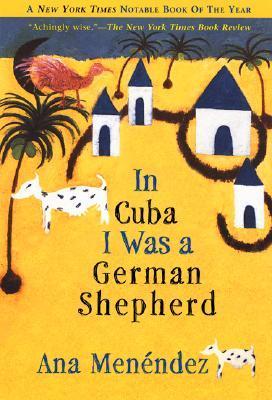
"In Cuba I Was a German Shepherd"
by Ana Menéndez, 2001