

Gabriela Ochoa is working to transform the perceptions of sharks and promote sustainable fishing practices along the coast of Honduras – an achievement earning her recognition from The Explorers Club, an international organization dedicated to the advancement of field exploration and scientific inquiry.
Integrating science, policy and community
A marine biologist and shark conservationist, Ochoa founded Honduras’ first nonprofit dedicated to marine conservation. The organization, ilili, whose name means "shark" in the Miskito language, focuses on protecting sharks and rays. Under her leadership, ilili established the first baseline for shark fisheries in the region and collaborated with the government to draft legislation that supports both marine life and local fishers. It is also the first conservation organization to operate within the indigenous Miskito territory.
“Gabbie's award is great recognition of her efforts to help conserve sharks and other marine life in a region where this has traditionally been somewhat neglected,” said Yannis Papastamatiou, associate professor of biology at FIU.
Ochoa’s work with ilili began during the COVID-19 pandemic, three years before she joined FIU in 2023. While working with the indigenous Miskito group in Honduras, she met her current advisors – adjunct professor Damian Chapman and Papastamatiou – who encouraged her to pursue her doctorate degree.
During an expedition in the Miskito Keys, she witnessed a fishing boat filled with sharks, including a 3.8-meter pregnant great hammerhead. Though Honduras is a designated shark sanctuary, economic necessity often drives illegal fishing, as the region lacks tourism and alternative livelihood opportunities. The trade peaks during Lent, when Catholics refrain from eating red meat, leading locals to consume dried shark meat, known as cecina. This observation led Ochoa to question the effectiveness of the sanctuary and eventually inspired the creation of ilili.
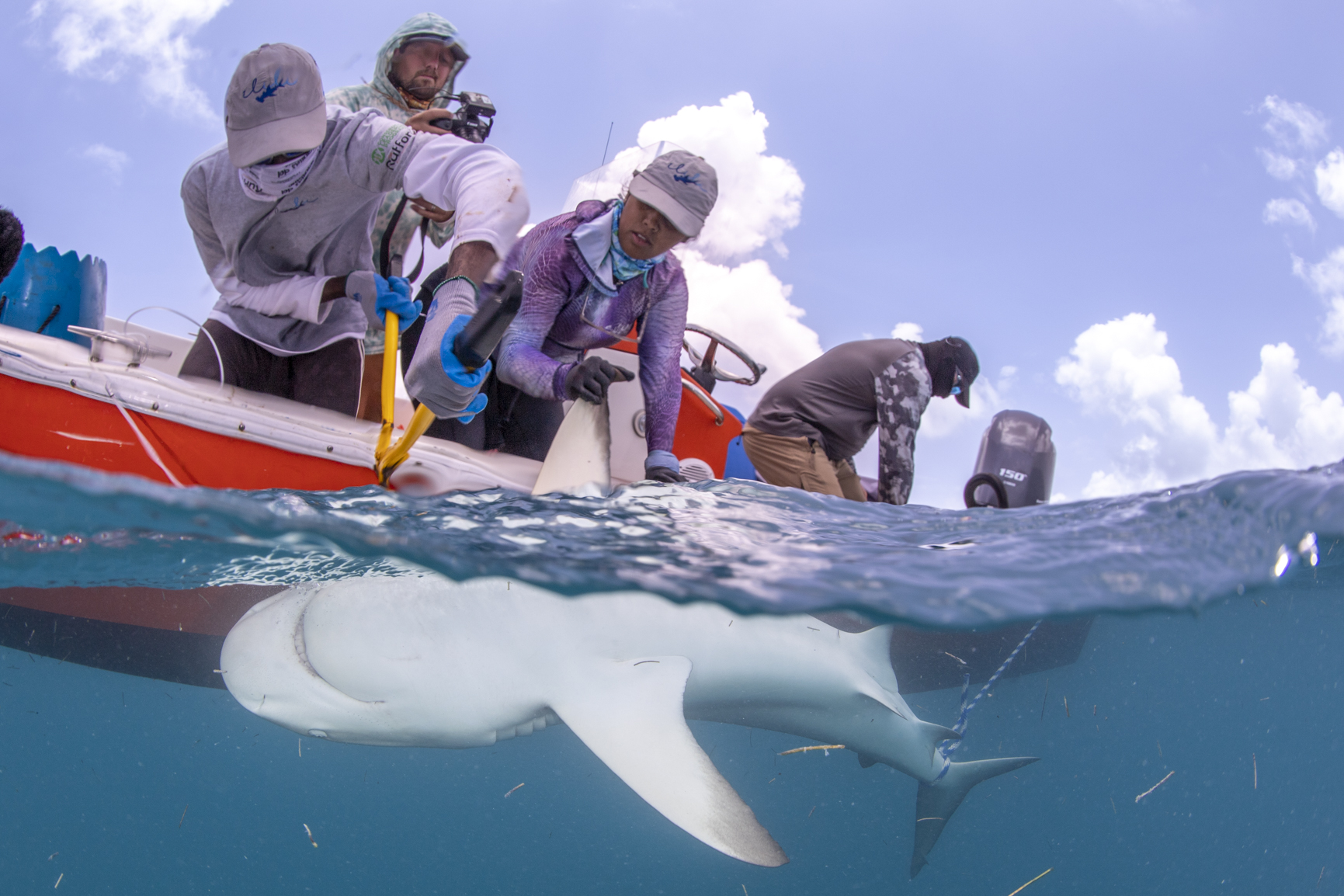
Gabriela Ochoa tagging reef sharks Photo credit: Patric Lengacher
Bridging research and regulation
Ochoa’s doctoral research focuses on shark movements and foraging ecology in Belize and Honduras, with particular attention on how sharks interact with spawning aggregations, events targeted by fishers. This overlap often leads to conflict.
“There are very few labs that work at the intersection of research and conservation,” Ochoa said. “We are working on applied science and things that can lead to better regulations and spatial protections for sharks.”
Recently, Ochoa served as an advisor and delegate for the Honduran government at the CITES CoP 20th meeting in Uzbekistan, helping guide proposals for the protection of multiple marine species while ensuring scientific data informed international policy.
"It was a full-circle moment where all the research we put through came to be in an international meeting," Ochoa said. "As researchers, we do the work, but seeing that research become policy is a different story."
 The Path Ahead
Ochoa is currently working on the Wan Kabu Ka (our seas in Miskito) project, funded by a grant through ilili, which aims to establish an Indigenous-led conservation area in the Miskito region. This area would be a marine protected space where Indigenous communities would agree on restrictions, working closely with territorial councils in the Miskito region.
Because Honduras was declared a shark sanctuary without consulting local fishers, the total ban on fishing and selling shark products has proven to be complicated. A significant, unregulated shark industry still exists. Ochoa is working closely with the fisheries department through the National Shark Working Group, a coalition of academics, non-profits and government officials, to transition to a more regulated system.
Ochoa plans to attend the Sharks International conference in Sri Lanka – which she refers to as the “World Cup of sharks” – and later meet with fellow Explorers Club members in New York this April.
She joins a remarkable list of past Explorer Club honorees as the fourth FIU scientist to gain membership, joining Diego Cardeñosa, assistant professor of biology; Mike Heithaus, executive dean of the College of Arts, Sciences & Education; and Mireya Mayor, executive director of strategic projects.