

Earth Day Spotlight: Florida International University showcases world-leading ocean science — from unique undersea lab to global shark conservation
This Earth Day, 60 feet below the surface of the ocean, off the coast of the Florida Keys, a research laboratory is collecting data on the health of one of the most biologically significant reef systems in the Western Hemisphere. It has been doing this for more than three decades.
FIU’s Medina Aquarius Program features the world’s only undersea research laboratory — a distinction the university has held since assuming operations in 2013 and full ownership in 2014. Recently outfitted with AI-powered monitoring and advanced sensor technology through a partnership with Tekmara, Aquarius is entering a new chapter as a real-time observation platform for understanding climate impacts on coastal South Florida ecosystems.
But Aquarius is only one part of a broader commitment to ocean science that spans ecology, policy, forensics and public engagement.
FIU marine ecologist Mike Heithaus has spent more than two decades studying the ecological role of sharks — work published in Science that has directly influenced international protection policy. Every shark species listed under CITES since 2016 traces back, in part, to research and advocacy led by FIU faculty. FIU’s Global FinPrint initiative remains the most comprehensive survey of reef shark populations ever conducted.
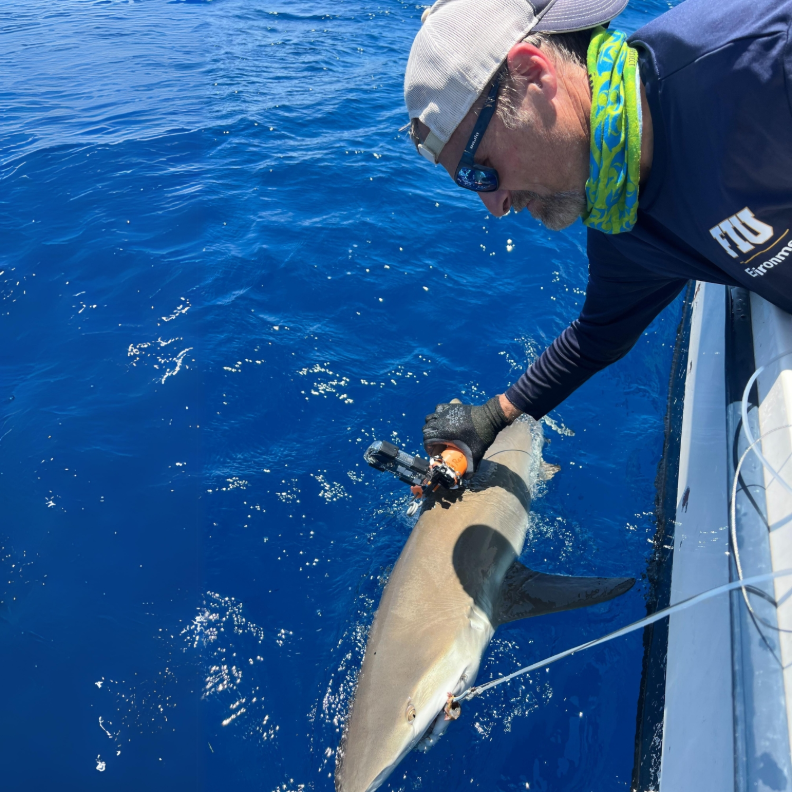
Meanwhile, marine biologist Diego Cardeñosa has developed portable DNA-identification tools that allow law enforcement to detect protected shark and ray species in the field — a frontline response to a global illegal wildlife trade valued at $20 billion. And marine mammal researcher Jeremy Kiszka’s lab is tracking how whales and dolphins respond to climate change, hurricanes, and maritime traffic across the Caribbean and Arctic. One of his tagged sperm whales transmitted location data for nearly 400 consecutive days.
FIU has also found an unexpected way to bring the public into the research itself. Through a partnership with Fahlo, consumers can purchase wildlife-tracking bracelets — now available in surf shops, natural history museums, gift shops and even at Epcot — that connect to animals being actively tracked by FIU scientists. A portion of every sale funds the research directly. It is one of the few models in higher education where a consumer product serves as both a science communication tool and a revenue stream for faculty research.
Taken together, these efforts represent something increasingly uncommon in university research portfolios: a sustained, multi-faculty commitment to a single ecological domain, with measurable policy outcomes, community-facing engagement, and infrastructure — including a laboratory on the ocean floor — that no other institution can replicate.
Earth Day invites institutions to talk about what they value. FIU’s ocean researchers are showing what it looks like to act on it. Learn more here.
If you find yourself in Miami April 22–24, visit FIU’s immersive Aquarius exhibit at eMerge Americas at the Miami Beach Convention Center. Experience the undersea lab up close and meet the researchers behind the work.