

Corals can remember past heat stress. Scientists are using that memory to save dying reefs
Coral can remember the past. Not in the same ways people do, of course, but they do form a sort of memory at the molecular level — a record of the stressful times punctuated by periods of pollution and prolonged heating.
This built-in ability to acclimate has brought a glimmer of hope to coral conservation. Until the complex underpinnings of the process are fully understood, though, stopping the loss of reefs may remain out of reach
This is where environmental epigeneticist Jose Eirin-Lopez comes in. With grants from the NSF and NOAA, he’s unpacking these mechanisms by studying epigenetics.
Put simply, epigenetics looks at chemical markers on DNA that play a role in switching genes “on” or “off.” These markers quickly respond to stress. When water temperatures spike, for instance, epigenetic changes that activate defense genes can help coral respond and recover. Eirin-Lopez’s team confirmed this in their experiments.
Replicating real-world scenarios in the lab, like marine heat waves, they’ve successfully mapped the appearance of markers that mirror the stress patterns and pinpointed signatures that distinguish resilient coral from less-resilient ones. It’s an early, but promising, sign it could be possible to generate heat-resistant varieties.
Eirin-Lopez has also pioneered the development of novel epigenetic toolkits for endangered staghorn coral, as well as dolphins, sharks and rays — all part of his goal to leverage the power of epigenetics for real-time monitoring and more effective conservation strategies.
“Every living thing is a product of its environment. Epigenetics has the power to reveal how organisms respond to changing conditions. Our goal is to use epigenetic markers to find a strain of coral that can thrive in current and future ocean conditions.”
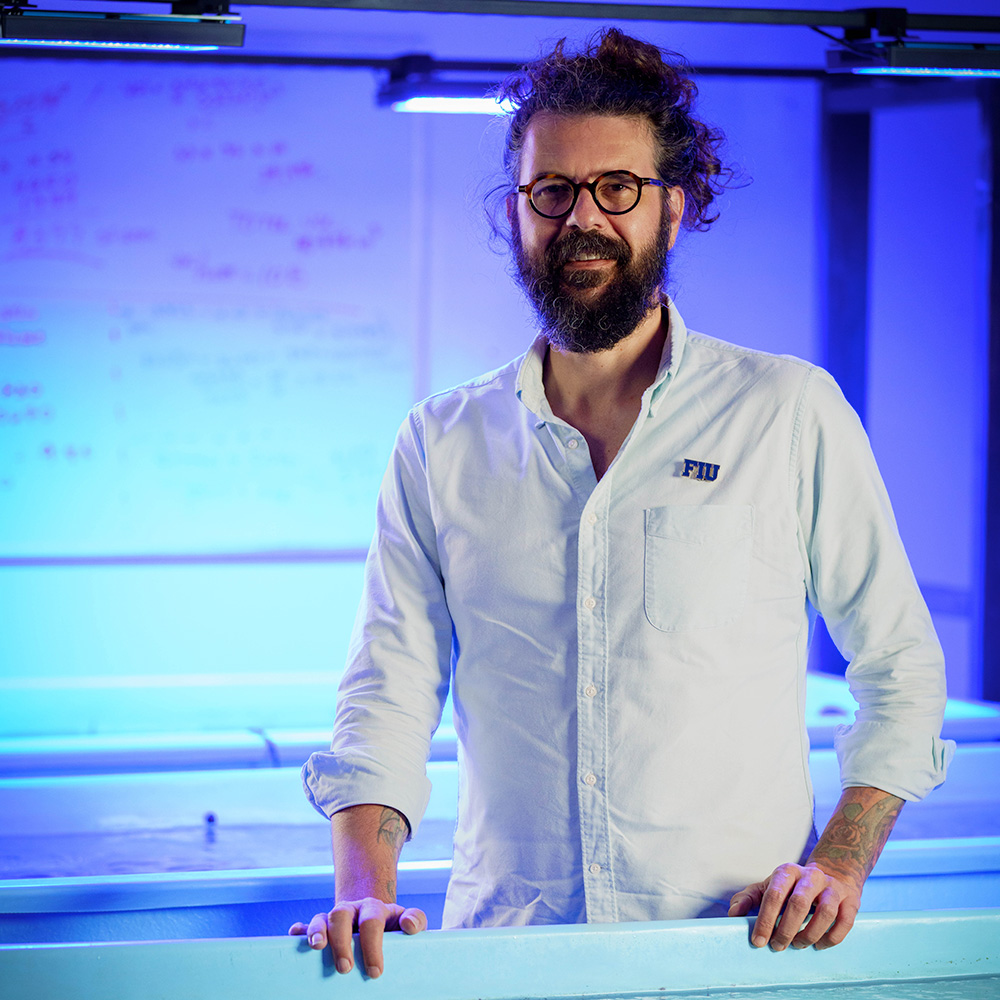
Jose Eirin-Lopez
Professor of Biology, Institute of Environment
College of Arts, Sciences & Education