

Cosmic data
The details of the Trifid and Lagoon nebulae came alive for human observers in 2025 as never before, thanks to the Vera C. Rubin Observatory in Chile. Inside the facility sits the world’s most powerful digital camera, one that nightly captures more than 800 pictures of the dark sky. At 3,200 megapixels each, they are the largest ever recorded — and over the next 10 years will provide a time-lapse of the universe that tracks supernova explosions, asteroids, meteors, black holes, far-off galaxies and more.
Making possible the transmission of the photos and their all-important metadata from a mountaintop in South America to Menlo Park, California, is FIU. Its 16,000-mile high-speed fiber optic network delivers the information, approximately every seven seconds for the duration of the camera’s daily activity, to SLAC National Accelerator Laboratory for processing and, ultimately, sharing with scientists and amateur stargazers around the planet. Developed over the course of two decades, the network builds upon infrastructure previously pioneered in the region by the university. FIU’s leadership, operation and oversight remain critical to fulfilling the observatory’s mission as a high-tech research tool that is revolutionizing how we explore worlds beyond our own.

Predicting preterm labor
What you see above, bursting with an exquisite rainbow-like shimmer of colors, is a mouse cervix viewed beneath a polarization-resolved second harmonic generation microscope.
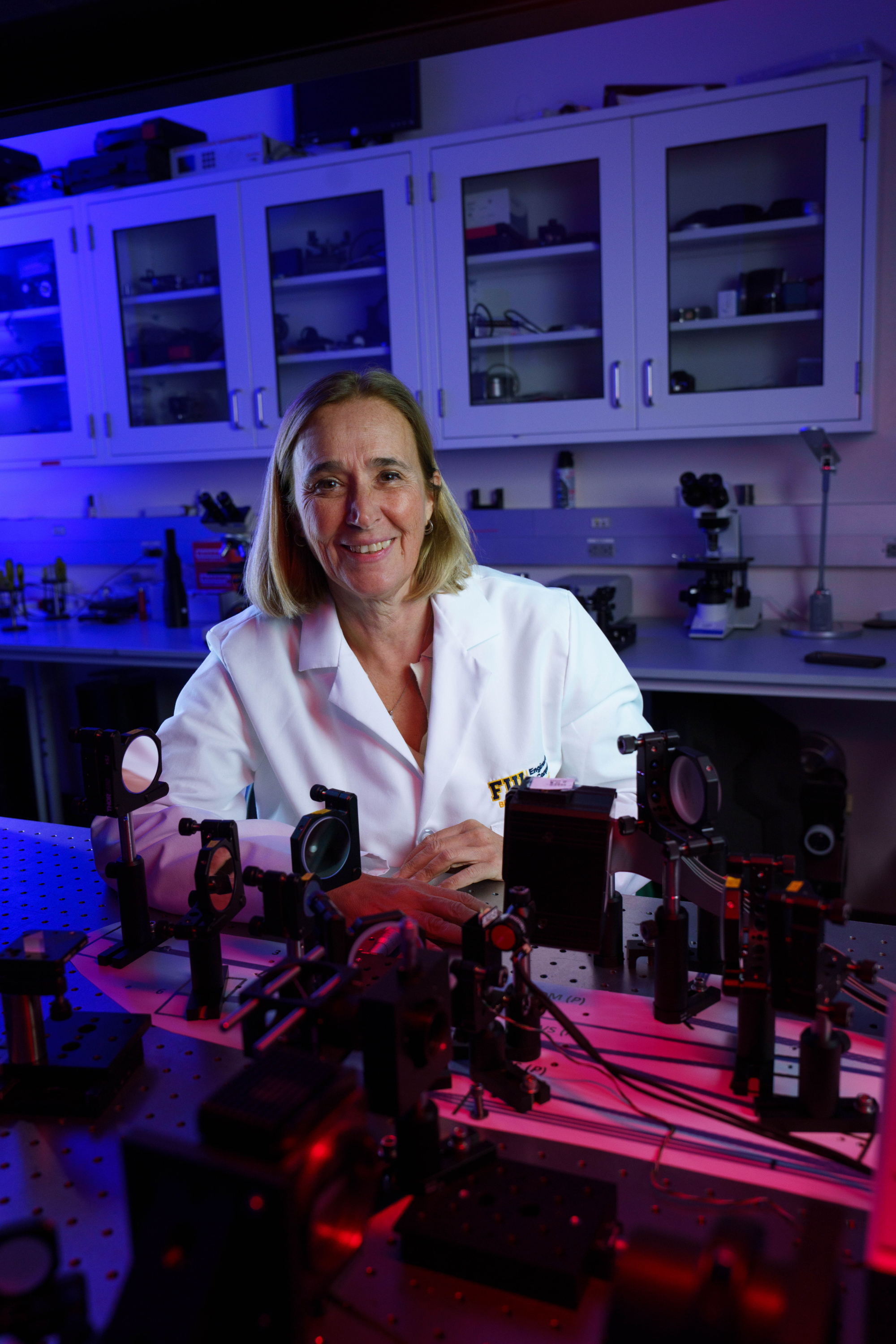 Jessica Ramella-Roman, a biomedical engineer in the College of Engineering & Computing, spent eight hours taking 81 images to create this detailed look at the web of collagen fibers that lend the cervix its impressive strength.
During pregnancy, these fibers remain tightly packed together. For a baby to enter the world, though, they must loosen and become randomly oriented. In preterm births, this remodeling process happens before it should.
A world expert in optical imaging, Ramella-Roman uses advanced techniques to visualize this process and detect signs of premature remodeling that typically signal preterm labor. With premature births on the rise in the U.S., early detection is critical. However, few current diagnostic tools are available, limiting timely interventions.
A proof-of-concept study tested a similar polarization-sensitive imaging approach on pregnant patients at Jackson Memorial Hospital in Miami, Florida, in collaboration with Assistant Professor Nola Holness from the Nicole Wertheim College of Nursing & Health Sciences.
More recently, Ramella-Roman’s lab has developed an easy-to-use, handheld cervical imaging device and completed the NSF Innovation Corps program to bring the invention to commercialization.

Where there’s smoke
Vaping and hookah smoking have surged in the U.S. And there’s a misconception these options are less harmful than cigarette smoking, though evidence suggests otherwise.
Wasim Maziak’s Clinical Research Lab for Tobacco Smoking at FIU is leading research to inform regulatory and policy efforts to curb the tobacco epidemic. One of their studies found that menthol-flavored e-cigarettes significantly increased user satisfaction, enjoyment, puffing intensity and interest in future use compared with tobacco flavor. Another study tested e-cigarettes with lower nicotine concentrations and observed “compensatory” puffing that led to a small increase in toxicant emissions.
Maziak, who is a distinguished professor at the Robert Stempel College of Public Health & Social Work, is also focused on developing health warnings for waterpipe devices. His lab has found that placing pictorial warnings directly on hookahs resulted in fewer puffs and reduced carbon-monoxide exposure, compared with unlabeled devices. Together, these studies support expanding health warnings to waterpipe devices and restricting flavorings and nicotine salts in e-cigarette products as promising regulatory strategies.