

Fingerprints of the sea: FIU researchers identify sharks with new technique
Every oceanic whitetip shark has a fin pattern as unique as a human fingerprint.
In a new study published in Marine Biology, FIU researchers identified more than 50 oceanic whitetip sharks by their fins alone using pelagic baited remote underwater video stations, pBRUVS, off the coast of Cat Island, The Bahamas.
The use of BRUVS is nothing new in the field of marine biology, according to the team, but the strategic use of pelagic BRUVS, or those not connected to the seafloor or a reef, was unique in this location due to the relative abundance of the critically endangered oceanic whitetip shark in the area and the depth of water.
“One of the key aspects of managing and conserving an endangered species — or any species — is being able to track trends in the population over time,” said Yannis Papastamatiou, an FIU marine biologist and researcher in the FIU Institute of Environment.
Is the population declining, stable or starting to increase?
“When you're talking about marine predators in the ocean, that’s very difficult to answer — much harder than with terrestrial predators,” Papastamatiou continued. “If you want an idea of the abundance of lions, you can do airplane surveys and count them. But in the marine environment, you can't see things, so that's very difficult to do.”
Previously, FIU researchers used BRUVS to survey a different species of shark over a 10-year period at an atoll. Through this study they were able to show that the relative abundance of this other species was declining even though the atoll was a protected area. But at Cat Island, the water was too deep to anchor cameras to the bottom of the ocean.
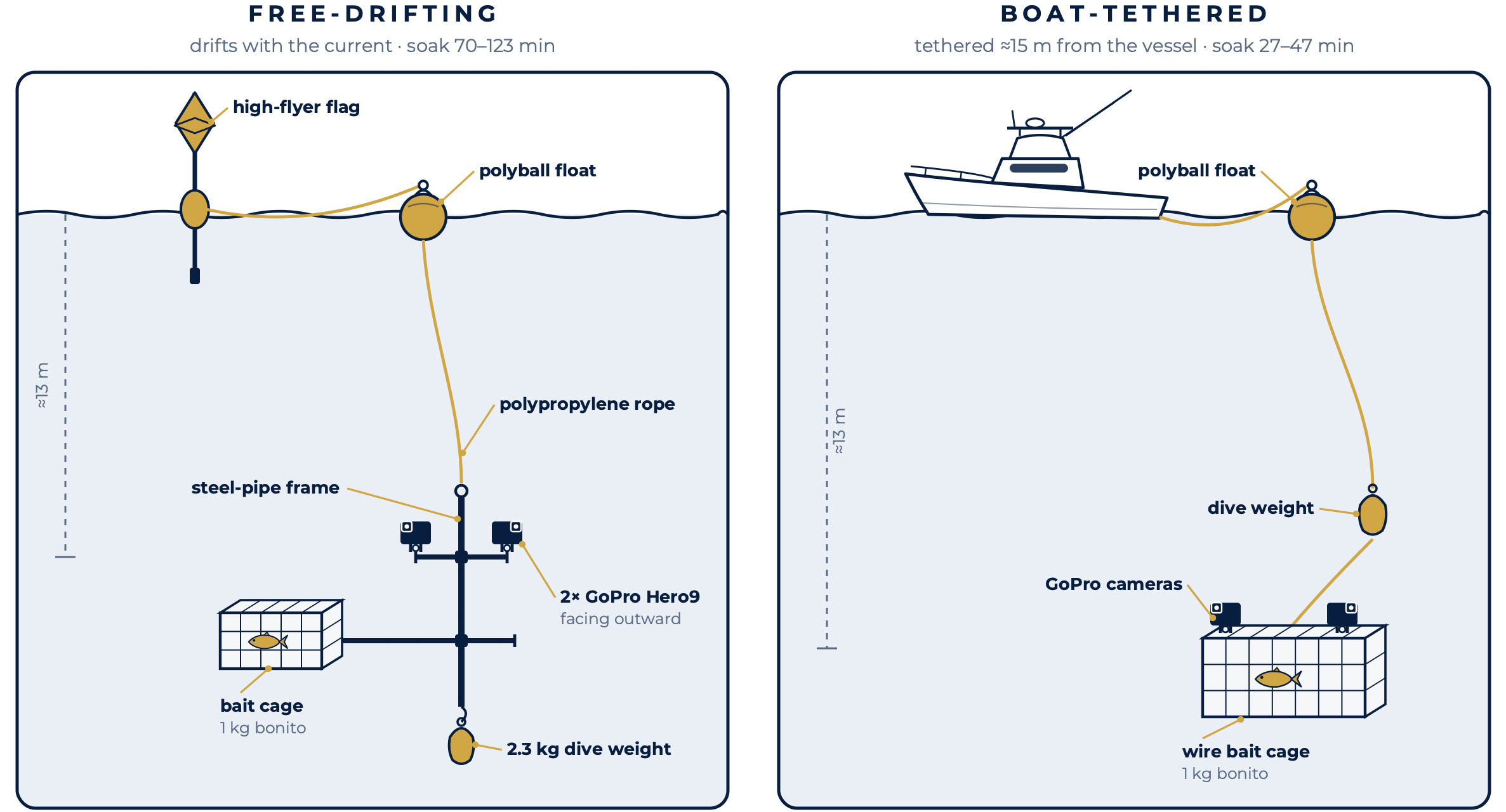
So, for this research, FIU alumna Candace Fields, who earned her Ph.D. in marine biology in 2025, tested two techniques of pelagic BRUVS: free-drifting and boat-tethered. According to Fields, free-drifting BRUVS were initially the main method of collection, but boat-tethered BRUVs let the team increase their sample size and test the influence of boat noise on shark behavior — which they found had no effect.
Similar to examining spot patterns on a whale shark, oceanic whitetip identification can be done by looking at their distinctive fin pigmentation as well as the shape of the tips of the fins, according to Fields.
“That's been done before, but using underwater photography, where you can position yourself or wait until the shark passes to get the right angle,” she said. “In a video survey, obviously, you have no means to control how the shark approaches the camera. So, one big question was: is this even viable? Are the sharks even going to give us enough of the correct angle to do this kind of identification?”
The method came with challenges. Sharks circled the pBRUVS, appearing on camera multiple times or approached the pBRUVS at angles that made their markings difficult to see. Even so, the researchers were able to identify individual sharks at what they estimate to be around 80% of the time.
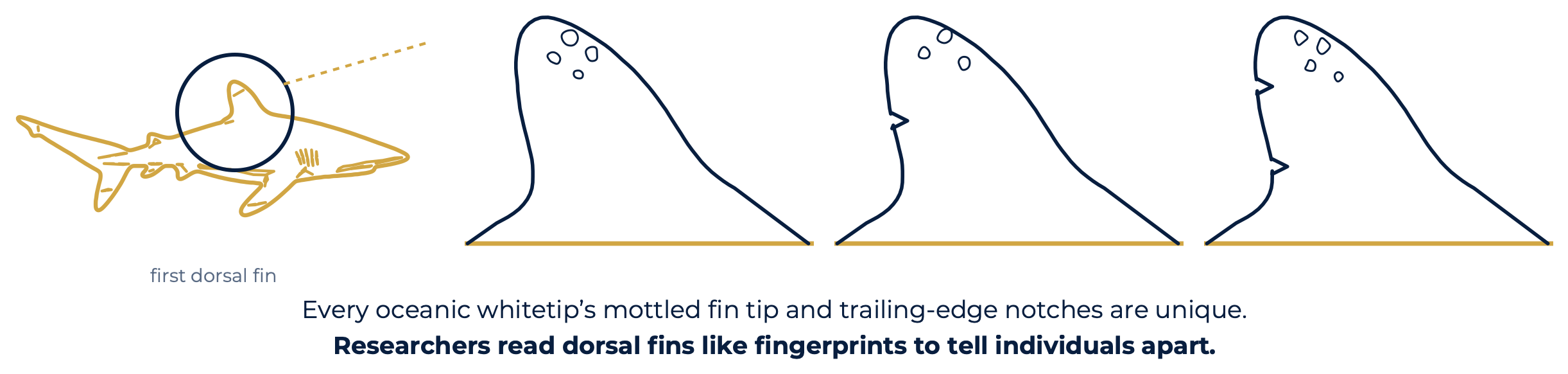
The ability to identify individual sharks also gave researchers a more accurate picture of how many sharks visited each camera. Traditional video surveys often rely on the maximum number of sharks visible at one time. But that can miss animals that arrive at different times. By recognizing individual fin patterns, the researchers found that the actual number of sharks visiting a camera could be up to three times higher than the traditional count suggested.
“If I can identify the individuals — even if only one is in frame at a time — I can look and say, 'actually, that was three different sharks,” Papastamatiou said.
According to Papastamatiou, the most important aspect of this project was demonstrating that this relatively cheap and easy camera method can be used as a tool to track relative changes in population size of the oceanic whitetip shark in The Bahamas.
Fields, now working at the Cape Eleuthera Institute (CEI) in Rock Sound, Eleuthera, Bahamas, closed with some of the valuable skills she gained through her PhD, “I think what FIU did for me was solidify the importance of coming back home to work. The Bahamas is a big hub for shark research, and there are little to no Bahamians involved in that work... what was encouraging to me was Yannis, and my other advisor, Demian Chapman, and their awareness of the importance of local nationals doing work in their own place — encouraging me to stick with it and be that Bahamian shark expert, so to speak.”
Future goals of the researchers are to expand the survey geographically to track whether the sharks linger or move up and down the archipelago. Additionally, Fields would like to incorporate citizen scientists’ photos into the project catalog so that they have increased coverage to track resighting’s year after year.