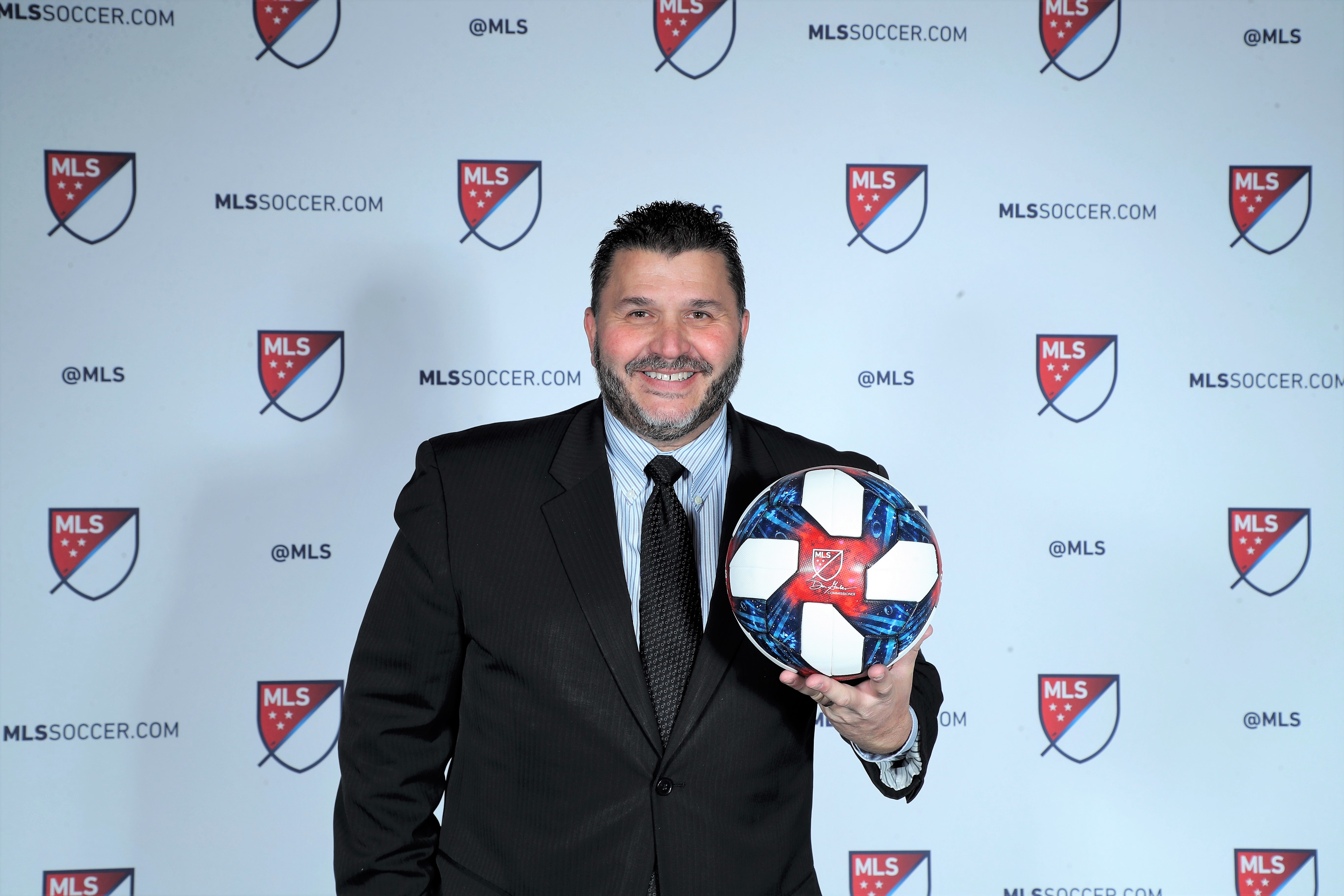
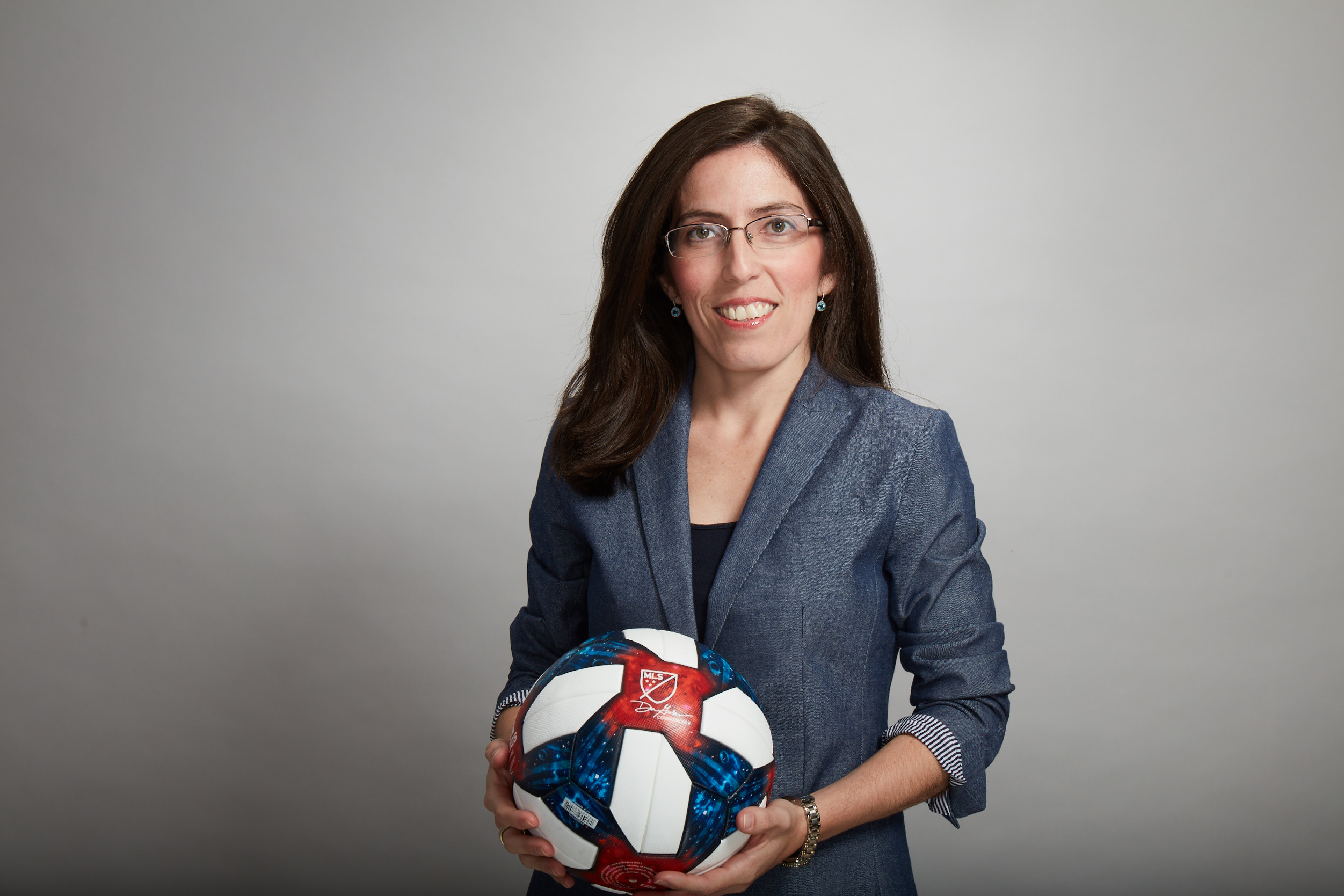
The FIFA World Cup 2026 is taking place in North America, and two FIU alumni are supporting one of the world’s largest sporting events from behind the scenes.
Gabriel Gabor ’88 and Marisabel Muñoz ’02, graduates of FIU’s School of Communication within the College of Communication, Architecture + The Arts (CARTA), have spent decades helping tell the story of Major League Soccer’s growth. Now, as the global spotlight turns to the United States, Mexico and Canada, both are preparing to play important roles in a tournament that reflects the remarkable evolution of soccer across the region.
Gabor is an international communication executive at MLS. He says accepting his current role with FIFA represents a full-circle moment.
“This is my first FIFA World Cup, but I have worked two FIFA Club World Cups (Japan 2025 and USA 2025),” he said. “To be a FIFA World Cup Media Officer, you have to be selected by the FIFA media operations team. It’s an honor to get selected.”
Assigned to the Monterrey venue in Mexico, Gabor is helping oversee media operations throughout the tournament.
“So I went from a fan in 1994 to having a key role in 2026,” he said. “I moderate team news conferences, liaison with the teams’ media officers and support the overall media operations of the stadium, among other things.”
Muñoz is the senior vice president for communications at Major League Soccer and its commercial marketing arm, Soccer United Marketing. She has worked for MLS for nearly 25 years and views the current tournament as both a milestone and an opportunity.
“I’ve had the privilege of working on every FIFA World Cup cycle since 2002, and each tournament has represented an opportunity to learn, evolve and help accelerate the growth of our league and the sport across North America,” she said.
“What makes the 2026 World Cup especially significant is the opportunity to showcase how MLS has delivered on the promise of the 1994 World Cup, while ensuring that the momentum and global attention generated by the World Cup strengthens MLS for years to come.”
Muñoz also highlighted the cooperation between FIFA and MLS communications professionals leading up to the tournament.
“In addition to my role with MLS, I’m excited by the unprecedented level of collaboration between MLS and FIFA communications teams, built on long-term relationships and mutual respect,” she said. “I’m extremely proud of our team of professional communicators and media operations experts who have been called in as media officers, venue media managers and other key roles to deliver a world-class experience for media, teams and stakeholders.”
The pair's involvement in FIFA World Cup 2026 represents the latest chapter in careers shaped by FIU and built alongside the rise of professional soccer in North America.
CARTA foundation builds versatile communicators
For Gabor, the breadth of his CARTA education provided the foundation for a career in sports communications that has spanned nearly three decades.
“My journalism track was well-rounded as I got to learn about different disciplines, like video production, magazine editing, law and ethics and other elements of the communications spectrum that came in handy even at my very first job,” Gabor said. “These are skills I continue to use in my day-to-day work.”
Muñoz said her experience at FIU prepared her to thrive in a constantly evolving, high-pressure environment.
“My time at FIU laid the foundation for working in a fast-paced environment like Major League Soccer,” she said. “It taught me how to think creatively but also strategically, how to communicate clearly and adapt quickly, which is essential in sports where the news cycle never stops.”
Witnessing the evolution of Major League Soccer
Both alumni have seen MLS grow from its early days into a globally recognized league featuring international stars and expanding audiences.
Gabor began his MLS career in 1998 as head of communications for the former Miami Fusion, during a period when the league was still establishing its identity in North America.
“Strong storytelling and branding was not optional, it was a necessity,” Gabor said. “We had to share our narrative with media, fans, commercial partners and local authorities on a daily basis. At first, all we had was a story and a dream.”
In those early years, building interest in the sport required creativity. Gabor recalled experimenting with unconventional promotions designed to attract attention and fill stadiums, including postgame concerts featuring acts such as The Village People and Ziggy Marley.
One of his most memorable campaigns was “KC Dollar Night,” a midweek promotion tied to a match against the Kansas City Wizards. Fans who brought a one-dollar bill containing the letters “K” and “C” anywhere in its serial number could use it as admission.
“Back then, MLS was still finding its footing, so we had to be creative to earn media coverage and get fans into the stadium,” Gabor said.
The promotion drew hundreds of fans and even caught the attention of Lamar Hunt, the legendary sports entrepreneur and owner of the Kansas City Wizards.
“For a young communications executive, it felt like the godfather of sports marketing had personally given me his seal of approval,” Gabor said.
He also reflected on how dramatically the sport has evolved since the early days of MLS.
“Who would have thought that almost three decades later we would grow to be one of the top soccer leagues in the world, home of its greatest player, Leo Messi?” he said.
Gabor further noted the contrast between today’s landscape and the 1994 FIFA World Cup.
“The biggest difference is that in 1994 there was no first-division professional soccer league in the United States,” he said. “Soccer was still viewed as a foreign sport. In fact, Major League Soccer was created as part of FIFA’s requirement for the U.S. to host the 1994 World Cup.”
Today, MLS includes 30 clubs across the United States and Canada and has become one of the world’s leading soccer leagues.
“Never in my wildest dreams did I imagine I would go on to spend more than 25 years working in MLS and eventually serve as a FIFA Media Officer at the next World Cup in the United States,” Gabor said. “It’s been quite a ride.”
Muñoz described the league’s evolution as “incomparable,” particularly in how it approaches storytelling and fan engagement.
“Today, MLS is a global property with world-class players, clubs, and infrastructure,” she said. “That growth has completely transformed how we approach storytelling, branding and fan engagement. We are building culture, connecting authentically with diverse audiences, and telling stories that resonate locally and globally.”
Fast-paced roles in a global sports organization
In their current roles, both alumni operate in dynamic environments that span domestic and international soccer properties.
“The best part of my job is that I don’t have a daily routine,” Gabor said. “In the international communications group at the league we work on both MLS and our international projects. On any given day, I might spend the morning working on the MLS All-Star Game and in the afternoon getting ready for a Mexico game at Chicago’s 60,000-seat Soldier Field.”
Throughout his career, Gabor has also worked on U.S. tours for some of the world’s most recognizable teams and national programs, including Argentina, Brazil, FC Barcelona and Manchester United.
Muñoz described her role as centered on strategy, collaboration and content development across the league’s clubs and partners.
“No two days are ever the same, which is part of what makes being a part of MLS so exciting while also being a big responsibility,” she said. “My role sits at the intersection of strategy, content and collaboration, working with our clubs, partners, and internal teams to help shape how the league shows up to media and fans.”
She also highlighted the significance of the 2026 World Cup 2026 being hosted across multiple MLS markets.
“Especially right now, as we gear up for the FIFA World Cup 2026 to be played across 13 MLS cities, there’s a real sense of momentum across the league,” she said.
Miami roots, global perspectives
Both alumni emphasized the importance of FIU’s the community and Miami’s global identity in shaping their professional perspectives.
Gabor said FIU’s multicultural environment provided a natural advantage for working in international sports communications.
“Attending a culturally diverse university like FIU provided me with a great base for my career path,” he said. “I can’t think of a job where my multicultural background and education was not a major asset.”
Muñoz also highlighted the connection between South Florida and the global game, noting the region’s increasing influence within MLS, saying, “South Florida has always been a gateway to the global game, and you see that reflected in the league today more than ever.”
She pointed to the rise of Inter Miami as “a perfect example of how that cultural connection can elevate a club and the league as a whole.”
Lillian Lodge Kopenhaver, executive director of the Kopenhaver Center for the Advancement of Women, and a professor of journalism, remembers the alumni. “Marisabel Muñoz and Gabriel Gabor are consummate communications professionals,” she said. “I have watched their amazing careers and am so very proud of both of them for what they have achieved. Seeing them mentor the next generation of storytellers, they are indeed exceptional role models and represent us exceedingly well.”
Advice for FIU students
Both alumni encouraged current CARTA students interested in sports careers to focus on experience, adaptability and relationship-building.
Gabor advised students to pursue hands-on opportunities early.
“Intern and volunteer,” he said. “Just about every entry-level colleague at MLS Communications interned or volunteered with a professional or college sports team. And make sure you can write well.”
Muñoz emphasized curiosity and professional networking as key to long-term success.
“Stay curious and be adaptable,” she said. “The industry is constantly changing, so being open to learning and evolving is key. Also, don’t underestimate the value of relationships. Your network and your reputation matter. And finally, be willing to say ‘yes’ to opportunities.”