A cycle-friendly pedestrian bridge designed by architecture professor Thomas Spiegelhalter has won the steel construction category of the 2026 Deutscher Metallbaupreis, Germany’s metal construction award.
The award recognized the construction company of Winterhalter Stahlbau for the bridge it built over the Kleine Emscher river in North Rhine-Westphalia, Germany. The company fabricated and installed the structure. The awards were presented Oct. 23 in Würzburg, Germany. The jury highlighted the combination of innovative manufacturing and technically demanding steel construction.
“This is my eighth award-winning bridge realization design, but the first in which I could integrate advanced evolutionary growth algorithms, AI-assisted generative design and extensive structural topological optimization, finite element analysis and cloud-based robotic metal additive G-coding and manufacturing tools, processes and workflows,” Spiegelhalter said. “What makes this achievement particularly meaningful is the collaboration among engineers, scientists, manufacturers and skilled craftspeople who worked through years of experimentation, testing and time-consuming, complex regulatory approvals to transform computational research into a fully realized non-cartesian structure. For me, this is the essential connection between research, professional practice and teaching.”
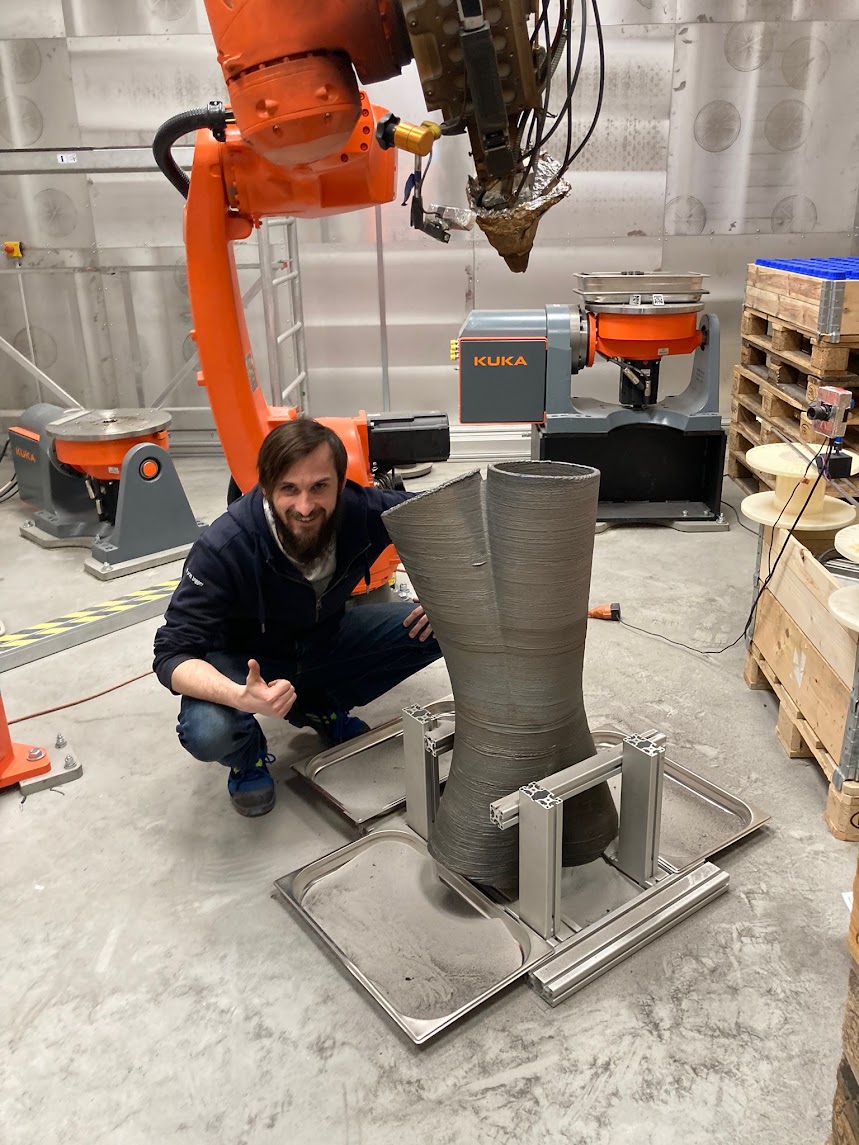
The 50-meter bridge, about 164 feet long, combines standard hollow steel sections with six custom stainless-steel connections, called nodes. These joints were made with robotic 3D printing using laser metal deposition. The printed components join the bridge’s larger steel members in a hybrid construction system.
Spiegelhalter’s design used AI-assisted generative design tools to develop the bridge’s asymmetric framework and refine the geometry of its connections. This computational approach allows designers to explore different structural arrangements. The project brought those digitally developed forms into construction through collaboration among architects, engineers and fabricators.
The bridge is part of the Green Window to the Rhine project, intended to open a formerly inaccessible industrial site as a public park. Its setting reflects a broader environmental recovery. Emschergenossenschaft, the regional water management association and project client, reports that the river has been freed of sewage and restored.
Environmental protection and resilience also informed the planning. In a 2022 paper, Spiegelhalter described surveys of local plants and wildlife and plans to avoid disturbing ecologically sensitive areas during construction. The design study considered wind and water loads, including forces the structure could face during flooding.
Engineers Matthias Pfeifer and Bernd Sum contributed to the project, and testing at the Karlsruhe Institute of Technology supported the development of the connections.
Winterhalter Stahlbau assembled the bridge in two days, then completed welding, painting and installation of the deck. Three glass sections in the walkway will let visitors look down at the structure and its printed connections, making part of the construction visible underfoot.
At FIU, Spiegelhalter is a professor in the Department of Architecture in the College of Communication, Architecture + the Arts and co-director of the Structural and Environmental Technologies Laboratory.
His influence also extends to the students he mentors. Juan Garcia '25, a graduate of the School of Architecture and former teaching assistant for Spiegelhalter’s Environmental Systems in Architecture 2 course, now owns his own firm. He reflected on the lasting impact of his mentorship.
“[Professor Spiegelhalter] expanded my wonder for the discipline by challenging me to consider how emerging tools and evolving algorithms were reshaping practice and the future of architecture, Garcia said. “…his continued mentorship has given me insight into his research and reinforced that his expertise was built through an enduring pursuit of knowledge. Working with him has shown me the value of approaching projects through new tools and multiple perspectives. The wonder he inspired continues to shape how I see and practice architecture” he continues.
The bridge is expected to open to the public before the end of the year.