

A dozen College of Engineering & Computing graduates are working on mission-critical aspects of NASA’s Artemis program, the effort to establish a long-term human presence on the moon by 2030. Last month, the Artemis II mission marked a major milestone by sending four astronauts on a 10-day lunar flyby.
Get to know a few of the FIU alumni powering the human journey through the cosmos.
Claudia Eyzaguirre
Claudia Eyzaguirre ’14 helps make spaceflight possible long before a rocket ever leaves the ground.
As an element operations manager at NASA, she works across teams, contractors and partner companies to ensure that the many systems inside a spacecraft are assembled correctly and ready for launch. It’s high-stakes, detail-driven work, exactly the kind she began preparing for as a student at FIU.
Eyzaguirre interned at NASA twice before landing a full-time role that quickly pulled her into the Artemis program, the agency’s effort to return humans to the Moon.
“Thanks to FIU, I’m here,” says the Venezuelan native who arrived in Miami with her family as a teen. “FIU did a great job preparing me. The professors challenged you but were also personable, and they took the time to have office hours and give you the extra help you might need to succeed.”
At the university, she built her foundation both inside and outside of the classroom. She was a member of Tau Beta Pi, the engineering honor society, competed in the SAE Aero Design model aircraft competition and conducted undergraduate research on nanomaterials.
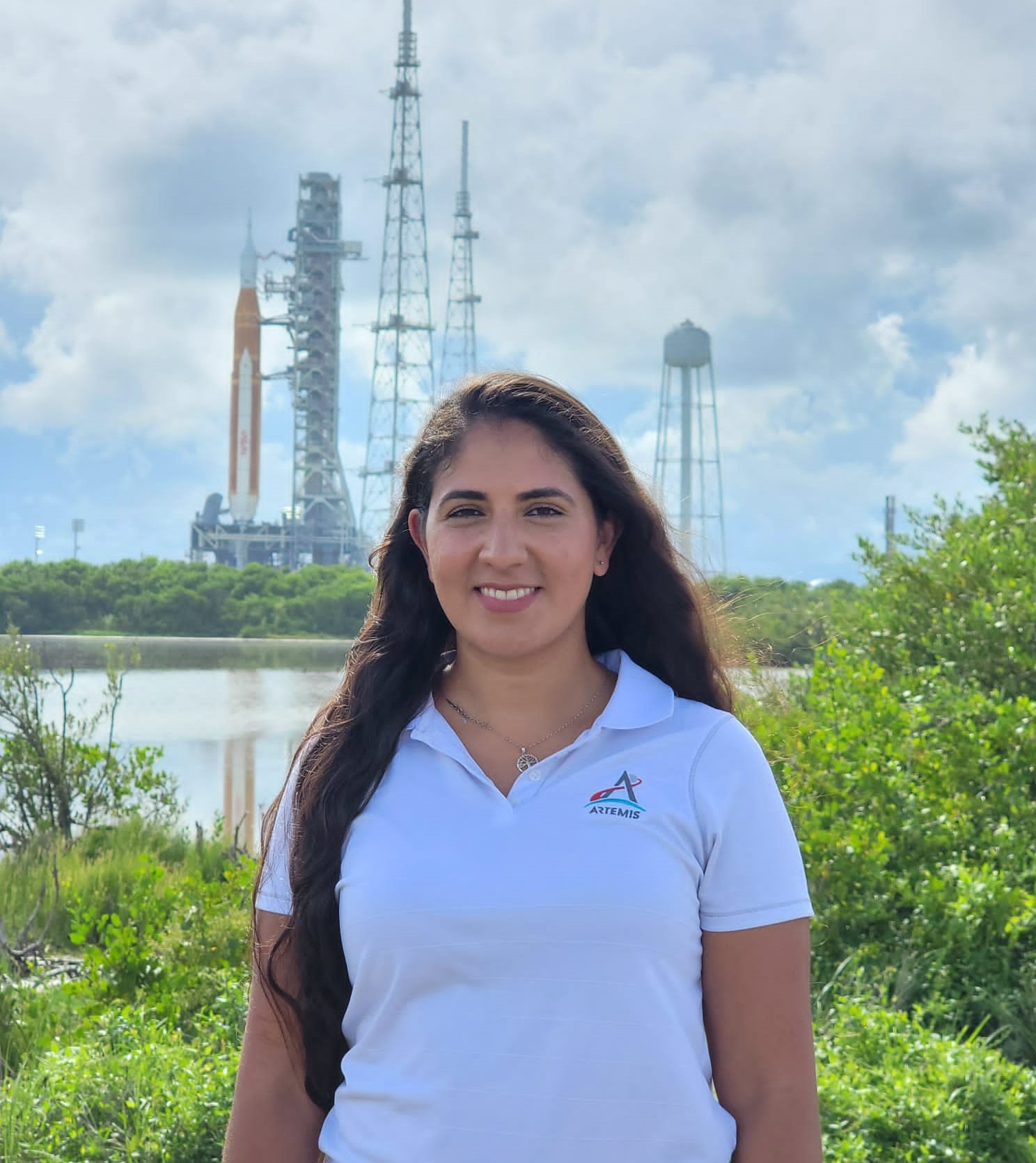
Her NASA career has taken her across the globe. She was selected for the highly competitive Systems Engineering Leadership Program, which took her to the Jet Propulsion Laboratory in California. There, she contributed to the Europa Clipper Mission, which aims to study Jupiter’s moon.
Through a NASA collaboration, she also spent nearly a year in France working as the director of a 2024 Space Studies program for the International Space University, an institution dedicated entirely to space education. In her role, she managed the development of the curriculum, taught a class and coordinated activities.
Already working on the Artemis III mission, she appreciates what the program means to both the country and herself.
“I feel so humbled that I was part of something so significant,” she says. “I’m so lucky to say that this is my job.”
Edsel Christopher Sanchez
Surrounded by FIU swag and sipping cafecito in his office at Kennedy Space Center, Edsel Christopher Sanchez ’03 is exactly where he always imagined he would be.
The Miami native realized his childhood dream of working for NASA, but the path started much closer to home. Growing up, he often drove past FIU’s Engineering Center, a constant presence that eventually shaped a big decision. When it came time to apply to college, he chose just one.
“FIU has everything I need to be successful,” he told friends. More than two decades later, that belief still holds. “I chose FIU, and it was a slam dunk for me, for my goals, for my passion.”
As an electrical engineering major, Sanchez seized a selective NASA internship during his senior year. The six-week experience turned into a job offer after graduation—and into a 22-year career. A self-described “lifer,” he has risen from system engineer to division chief of technical performance and integration.
Along the way, he leaned on the same lessons he first developed at FIU: rigorous academics, collaboration and connection.
“That’s one of our NASA core values: teamwork. We can’t really launch rockets, we can’t really design stuff without being part of a team.”
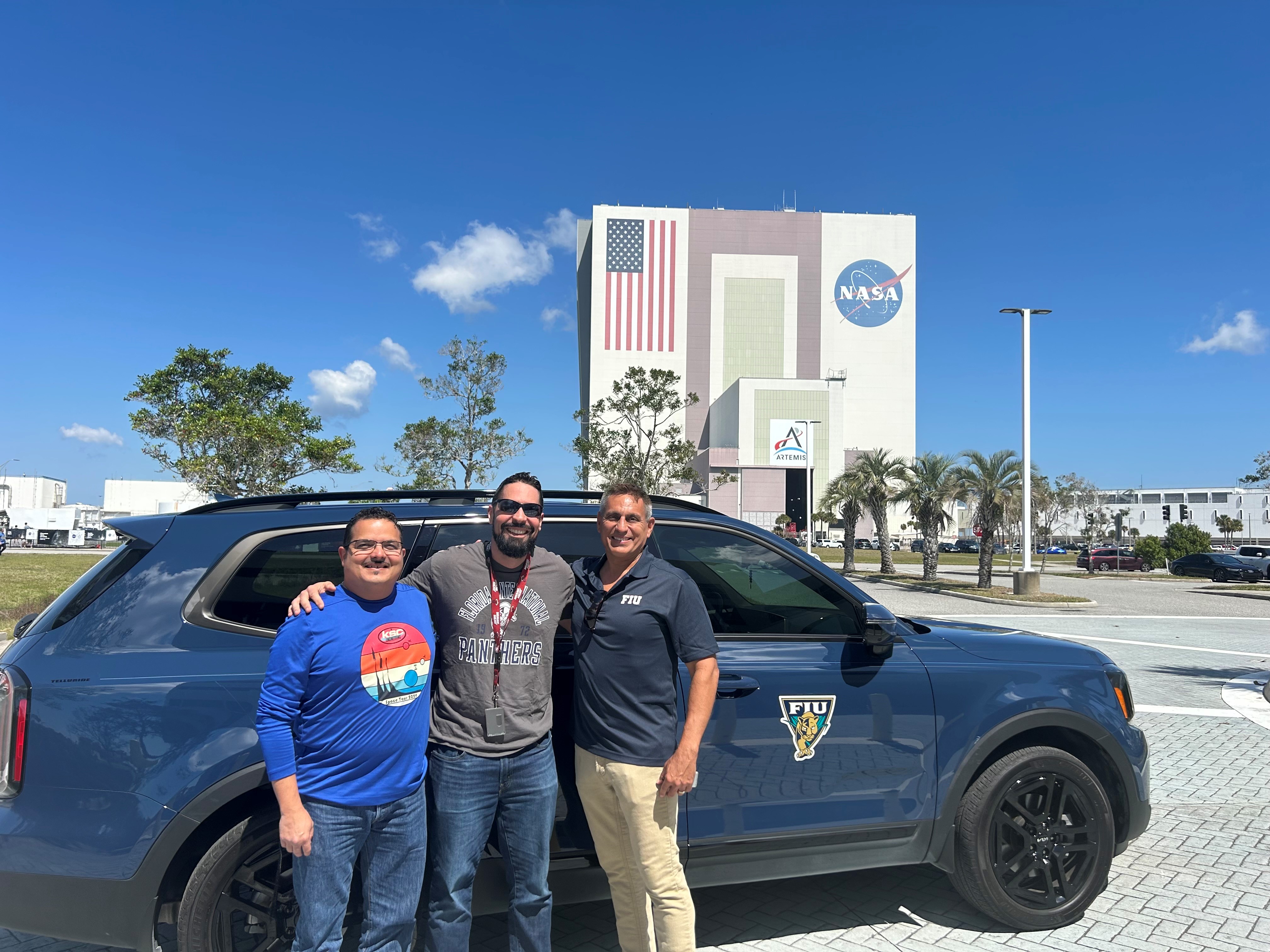
At FIU, Sanchez learned not only how to innovate and think creatively, but also how to plug into a broader professional community. Through his involvement in Eta Kappa Nu, Tau Beta Pi and FIU’s chapter of the Society of Hispanic Professional Engineers, he built meaningful connections.
Today, his division plays a critical role in NASA’s Artemis efforts, ensuring that complex systems operate in sync and infrastructure is ready to support each mission.
“We also do all the major construction of infrastructure that supports Artemis…from the liquid hydrogen tank that is used as fuel [to] the construction of the platforms used in vehicle assembly.”
His team—about 170 people—functions as a single unit, reflecting the same teamwork he has valued since his college days.
In recent years, Sanchez has shifted toward project management, overseeing schedule, scope and cost while keeping progress on track. It’s a role that calls for the kind of leadership skills he began developing as an undergraduate and continues to rely on today.
“I’m very thankful for FIU.”
Allan Villorin
Allan Villorin ’11, MS ’17 credits the Honors College with steering him to the moon.
The double alumnus has spent 17 years at NASA. His bachelor’s degree and online master’s in computer engineering set him up perfectly for his current role in as launch control system chief architect.
Villorin is responsible for the work of 200+ engineers. They design the advanced software and hardware at Kennedy Space Center to manage ground-based testing, fueling and countdown procedures for NASA’s most-powerful rocket and the crewed spacecraft. The launch control system enables the processing of up to 575,000 data updates per second to monitor vehicle health and command systems.
“I reflect a lot on how challenging FIU was,” the rocket scientist says of his foundation. “It was very tough, a lot of long evenings working on projects and studying. I look back, and I really appreciate that it prepares you for the challenges you’re going to encounter in your professional career.”
The technical and teamwork skills he learned years ago come in handy at an organization as diverse and large as his.
“There are thousands and thousands of engineers working on this across the nation,” Villorin says of the Artemis program that is the agency’s main focus right now. “Everybody's working on their own piece, but then it all has to eventually come together. That's where we find a lot of bugs, a lot of things that don't work the way we thought they would, and that's when we go back to testing again and again until we are able to get everything perfectly down.”
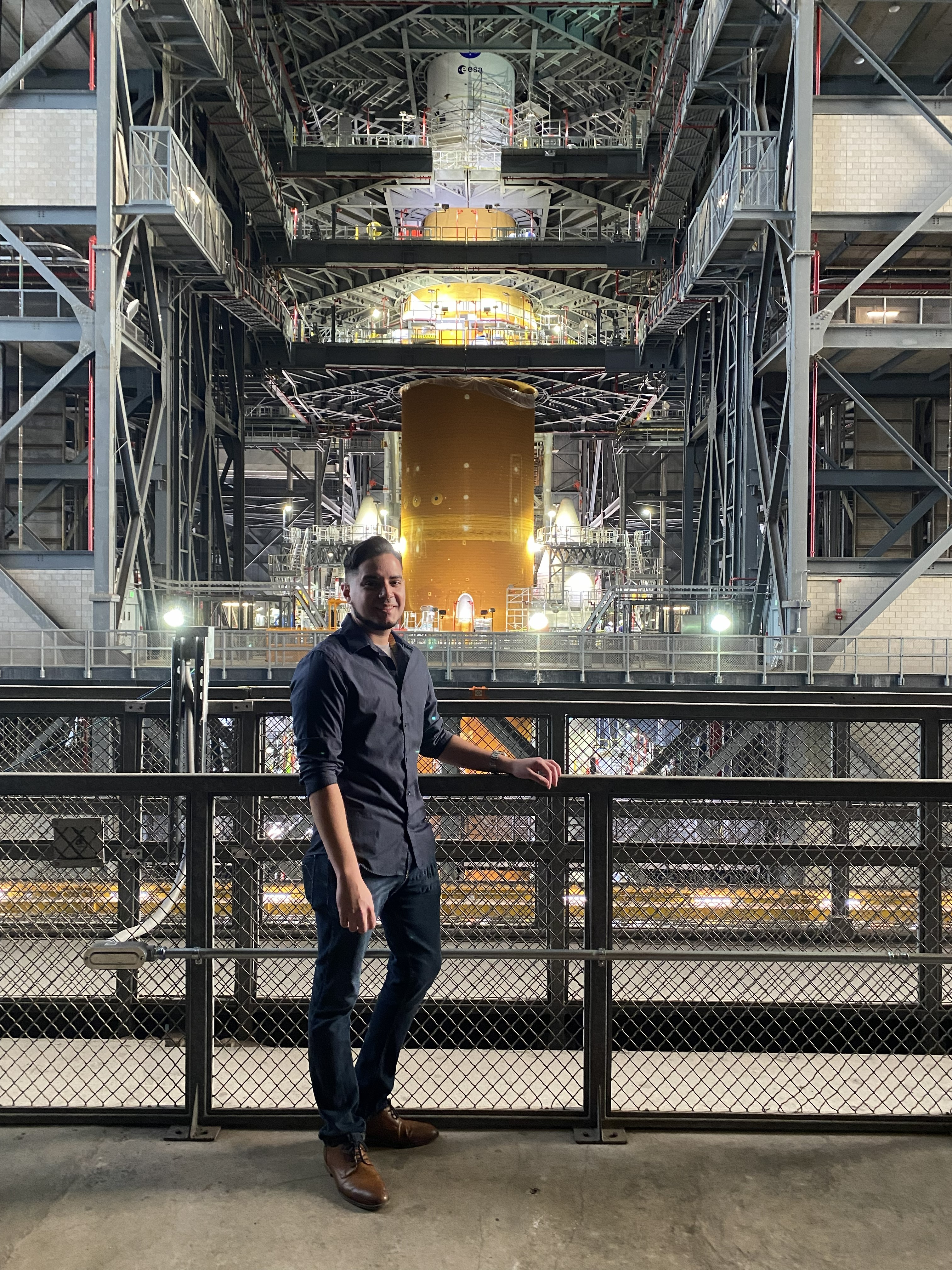
While the College of Engineering & Computing provided him with a rigorous undergraduate STEM background, he also enrolled in the Honors College.
The small liberal arts-style academic unit within the larger university served as something of a gravitational force for Villorin by promoting “a broadened horizon” and the chance to “view the world differently” at a time when other courses grounded him in “numbers and coding and formulas,” he says.
“The Honors College gave me an opportunity to experience the philosophical side of college,” he continues. “Just being able to talk to your professors and have open dialogue, converse about current events and different things because otherwise I would've just been head down in the books.”
And he says folks there literally put NASA in his orbit.
“They sent out emails for internship opportunities every so often, and one of them caught my eye, which was the NASA one,” he recalls. “I wasn't sure I'd even ever have a chance to do something like what I'm doing now, but I applied. The first time, I never heard back. I applied a second time and didn't hear back. And then I decided, let me try one more time. . .”
And now he’s making history.