
A joyful splash: Adapted swim lessons improve water safety skills for children with autism
Autistic children are 160 times more likely to drown than their neurotypical peers, highlighting the importance of providing water safety lessons tailored to their needs.
FIU researchers Tana Carson and Tania Santiago Perez are addressing this important problem by preparing future therapists to play a key role in keeping autistic children safe in and around the water.
Occupational therapists help children with disabilities master essential everyday skills, such as handwriting and riding a bike, while recreational therapists focus on developing leisure and recreation skills. Although occupational and recreational therapists play vital roles, swim instruction – a lifesaving skill – has not traditionally been included in their training.
To address this gap, Carson, an assistant professor of occupational therapy in FIU’s Nicole Wertheim College of Nursing and Health Sciences, and Santiago Perez, an associate teaching professor of rehabilitation and recreational therapy in FIU’s College of Arts, Sciences & Education, created an evidence-based program that prepares students – future physical, occupational and recreational therapists – to teach swimming and water safety to autistic children.
“My dream is that by creating a curriculum to equip therapy professionals with the skills to teach swimming and water safety, we can impact countless children and, hopefully, help save lives,” Carson said.
Carson and Santiago Perez’s approach offers training to rehabilitation professionals to prepare them to provide the continuum of water safety services from water safety education on land to adapted swimming instruction in the water through individualized intervention techniques. The program incorporates visual supports and therapeutic approaches to teaching new skills.
In partnership with the YMCA of South Florida’s Y-Swim Buddies program, Carson and Santiago Perez are currently leading a pilot study to track children’s skills over time. They hope to expand the curriculum to universities nationwide.
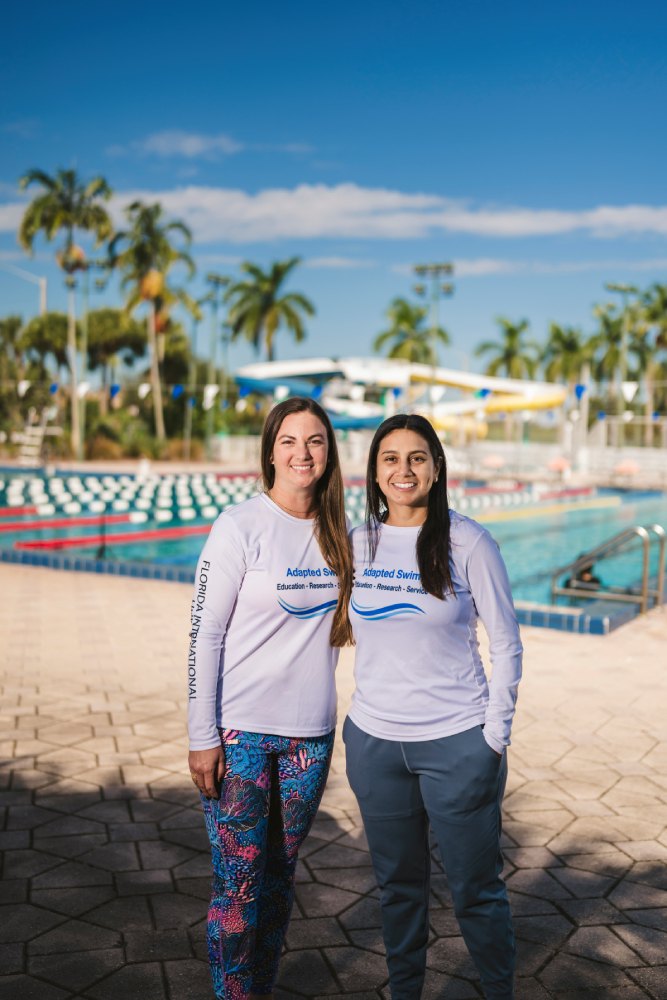
Tana Carson and Tania Santiago Perez

The program builds on research by Carson and Santiago Perez, published in Frontiers in Rehabilitation Sciences. The study examined 164 children with disabilities who participated in five-day swim programs across the United States. The children, ages 3 to 18, were assessed on their swim abilities at the beginning and end of the program.
By the end of the five days, many had made clear progress.
Swim skills were measured on a four-level scale, from non-swimmer to advanced. Overall, almost 62% of participants improved by at least one level. The number of children classified as non-swimmers dropped from 53% at the start of the program to just 22.5% by the end.
Autistic children showed similar gains, with 62.5% improving by at least one level.
The program focuses on adapting how skills are taught – breaking them into smaller steps, allowing time to build comfort and addressing challenges such as fear of the water.
Among children who did not improve during the five days, instructors most often cited fearfulness as the top reason for autistic children. For children with Down syndrome, the most common explanation was they needed more time to practice.
While the study focused on short-term gains, the researchers say the implications are broader. Helping children build even basic swimming skills can improve confidence, increase independence and, most importantly, reduce risk.
“Every child deserves the chance to be safe in the water,” Santiago Perez said. “This is one step toward making that possible.”
Carson’s and Santiago Perez’s drowning prevention research has received funding from the Carolyn L Tarloff Occupational Therapy Endowment, FIU Embrace, as well as the Office of the Assistant Secretary of Defense for Health Affairs through the Autism Research Program under Award No. HT9425-25-1-0126 (or AR240070).