

Florida sargassum could become food, researchers say
Each summer, thick mats of sargassum seaweed wash onto Florida beaches, bringing with them an unmistakable smell, costly cleanups and disruptions to animal conservation efforts. And this year we are likely to see a record-breaking amount hit Florida shores, with an estimated 10 million metric tons of sargassum already floating in the Atlantic. But what if that seasonal nuisance could become something useful?
Florida International University researchers are exploring ways to turn sargassum from waste into a valuable food ingredient. The findings are published in Food Hydrocolloids as part of a multi-institutional collaboration. The study included researchers from Florida State University, Florida Atlantic University and Florida International University.
Imran Ahmad, a co-author on the study, is a food scientist at FIU’s Chaplin School of Hospitality & Tourism Management. Ahmad contributed to the conceptual development of the broader project, which is being carried out in stages across partner institutions.
Below, Ahmad explains how and why sargassum might appear in our food one day.
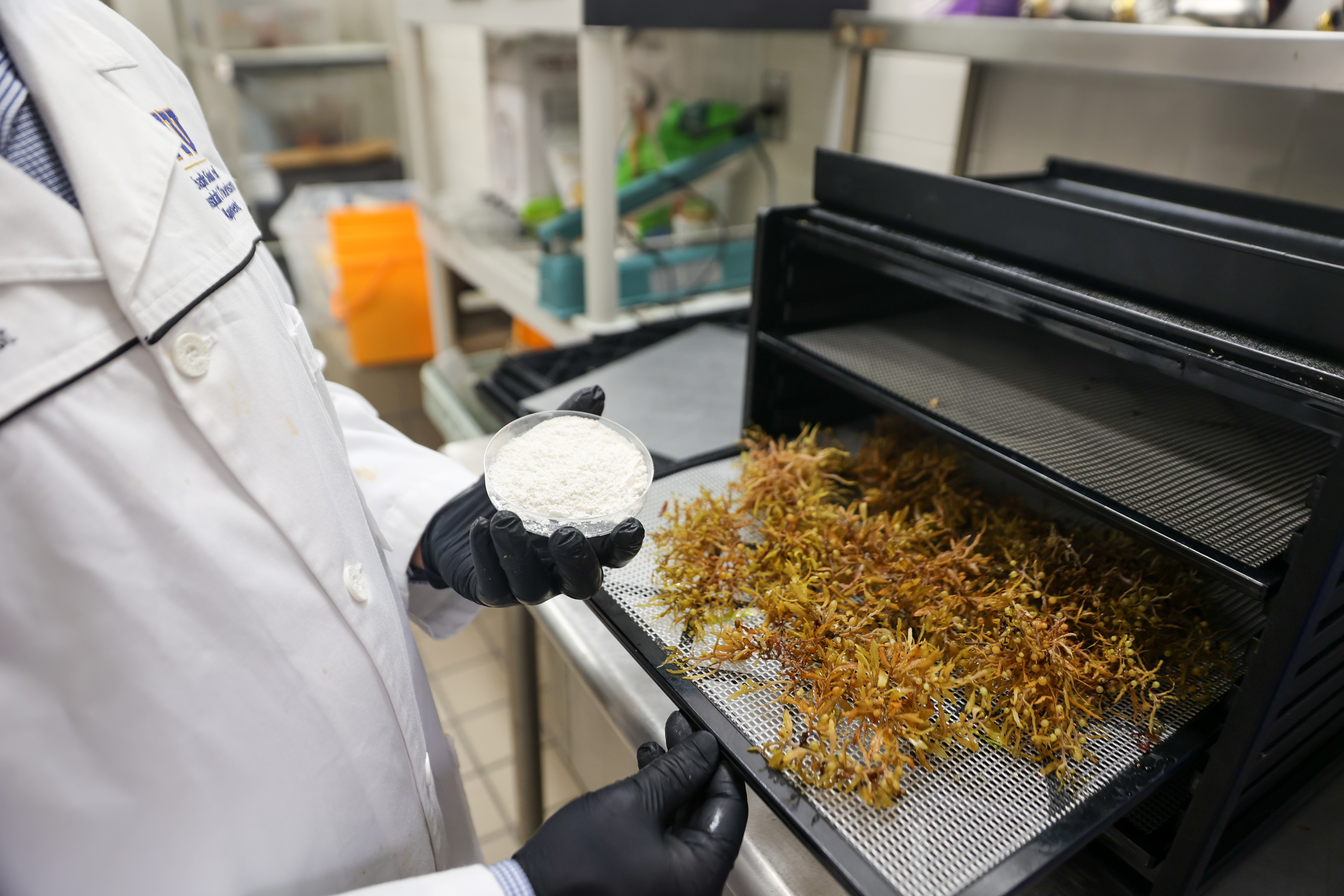 Ahmad holds up sodium alginate, the final product of the extraction process, while seaweed sits on a drying rack.
Why is sargassum such a problem in South Florida?
Sargassum is a type of brown algae that appears in large blooms, especially along the Atlantic coast. Every summer, we see it wash ashore in large amounts. It’s generally treated as waste because it smells, affects tourism and can carry contaminants or bacteria. On top of this, it is costly to remove.
What inspired your team to study it?
The usual approach has been, “How do we get rid of it?” We wanted to ask a different question: “Can we use it for something valuable?” For example, we extract high-fructose syrup from corn to make things sweet, and we extract agar from macroalgae to turn things into jellies. Since sargassum is a type of algae, we thought it might contain useful compounds, even if it’s not traditionally used as food.
What did your research find?
We found that sargassum contains compounds like alginate, that can be extracted at relatively high levels, roughly 45% of yield. Alginate is widely used in the food industry as a natural ingredient that helps stabilize and thicken foods. You’ll find it in products like ice cream and other dairy or dairy-like products.
Alginate is a complex carbohydrate which means it is slow burning and can help give athletes the energy they need when they need it, not like sugars which give you energy now, but lead to a crash later. This is why alginate is a popular ingredient in sport nutrition products.
But sargassum isn’t considered safe to use, right?
That’s correct. It’s not currently classified as a food source, and it can carry harmful bacteria or contaminants. There are also regulations about how it can be collected, by Florida law it must wash ashore naturally before it can be handled. So, before anything else, we had to figure out how to make it safe.
How did you do that?
We used a technique called high-pressure processing. It’s already used in the food industry—for example, in packaged guacamole and juices—to kill bacteria while keeping food fresh.
Instead of using heat, which can damage nutrients and structure, we apply extremely high pressure. Think of putting the equivalent of 10 elephants on top of something. That high pressure kills harmful microorganisms but preserves the useful compounds we want to extract.
How far along is this research?
We think of it in three stages. First, we analyzed the material to understand its safety and potential utility. Second, we extracted useful compounds like alginate and compared them to other extraction processes. This is where we are now, and those findings were just published.
The third step would be developing actual products that people could use, like ice cream, or something else, but we’re not there yet. That requires more funding and testing, and eventually regulatory approval.
What’s the bigger goal of this research?
Sargassum has economic and environmental impacts which affect tourism, create cleanup costs and can even cause public health concerns. If we can turn it into something useful, we shift the conversation from disposal to opportunity.
It’s all about sustainability. We’re looking for alternative sources of ingredients and new ways to process them without damaging quality. That helps reduce pressure on traditional supply chains and supports future food systems. Sargassum and high-pressure processing might be two ways to achieve this.
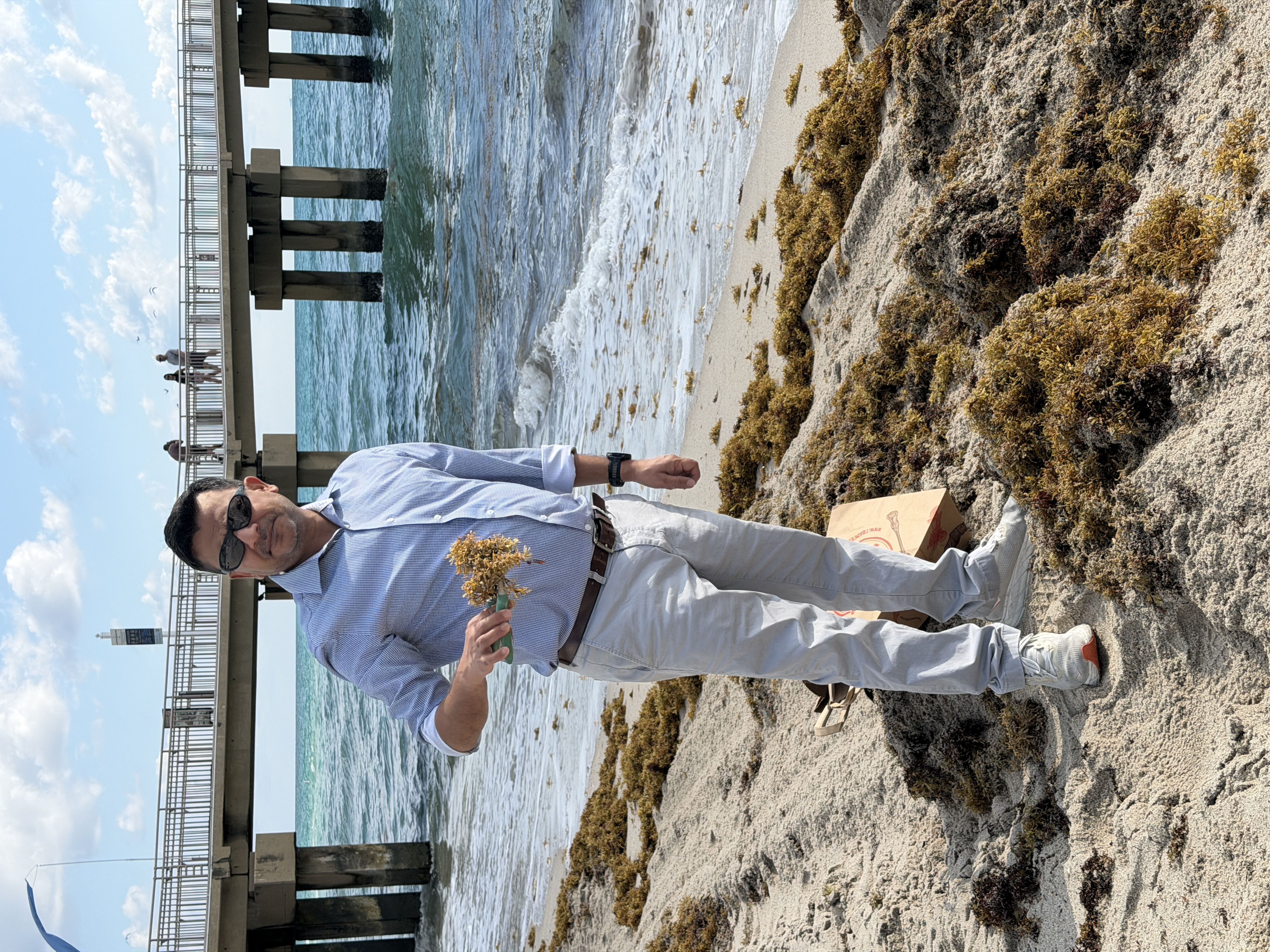 Ahmad collects sargassum from a Florida beach.
The study was conducted by a team of researchers from Florida State University, Florida Atlantic University and Florida International University, including Aravind Kumar Bingi, Yaqi Zhao, Yu-Jou Chou, Chunya Tang, Banghao Chen, Jeremy D. Owens, Brian E. Lapointe, Rachel A. Brewton, Imran Ahmad and Qinchun Rao.