

From classroom to operating room
Natasha Mazinani never imagined she would be in an operating room during robotic heart surgery.
Mazinani had just completed her first year at FIU Herbert Wertheim College of Medicine (FIU Medicine) when she found herself in an operating room at Baptist Health South Miami Hospital, watching Dr. Makoto Hashimoto and Dr. Tom C. Nguyen perform robotic heart surgery.
“When I walked into the room, I was a little nervous. I had never seen a robotic case before, so I didn’t really know what to expect,” Mazinani said. “I saw everyone preparing the patient, so I just took a moment to take it all in. It was mind-blowing for me, honestly.”
The moment capped a journey that had begun only months earlier.
“I did not expect the inside of the heart to look like that when they put the cameras in and I was watching it happen on the screen,” she said. “It was amazing.”
Late in her first semester, Mazinani read that the world-renowned robotic surgeon had joined the FIU Medicine faculty. Hashimoto is a professor and director of robotic cardiac surgery in the Department of Cardiovascular Sciences and a cardiac surgeon at Baptist Health Miami Cardiac & Vascular Institute. She remembers being impressed by his work advancing minimally invasive surgery — procedures that often lead to shorter recovery times and fewer complications than traditional open-heart operations. She thought about her own grandfather who underwent traditional open-heart surgery and the ordeal he went through.
A few months later, in March, she met the medical school’s dean, Dr. Juan C. Cendan, while completing an OSCE — an Objective Structured Clinical Examination used to assess clinical skills.
As they discussed the technical steps of evaluating the musculoskeletal system, Cendan invited Mazinani to meet with him to talk about mentorship. In early April, she sat in his office as he described observing a new faculty member perform robotic heart surgery.
Mazinani immediately knew who he meant.
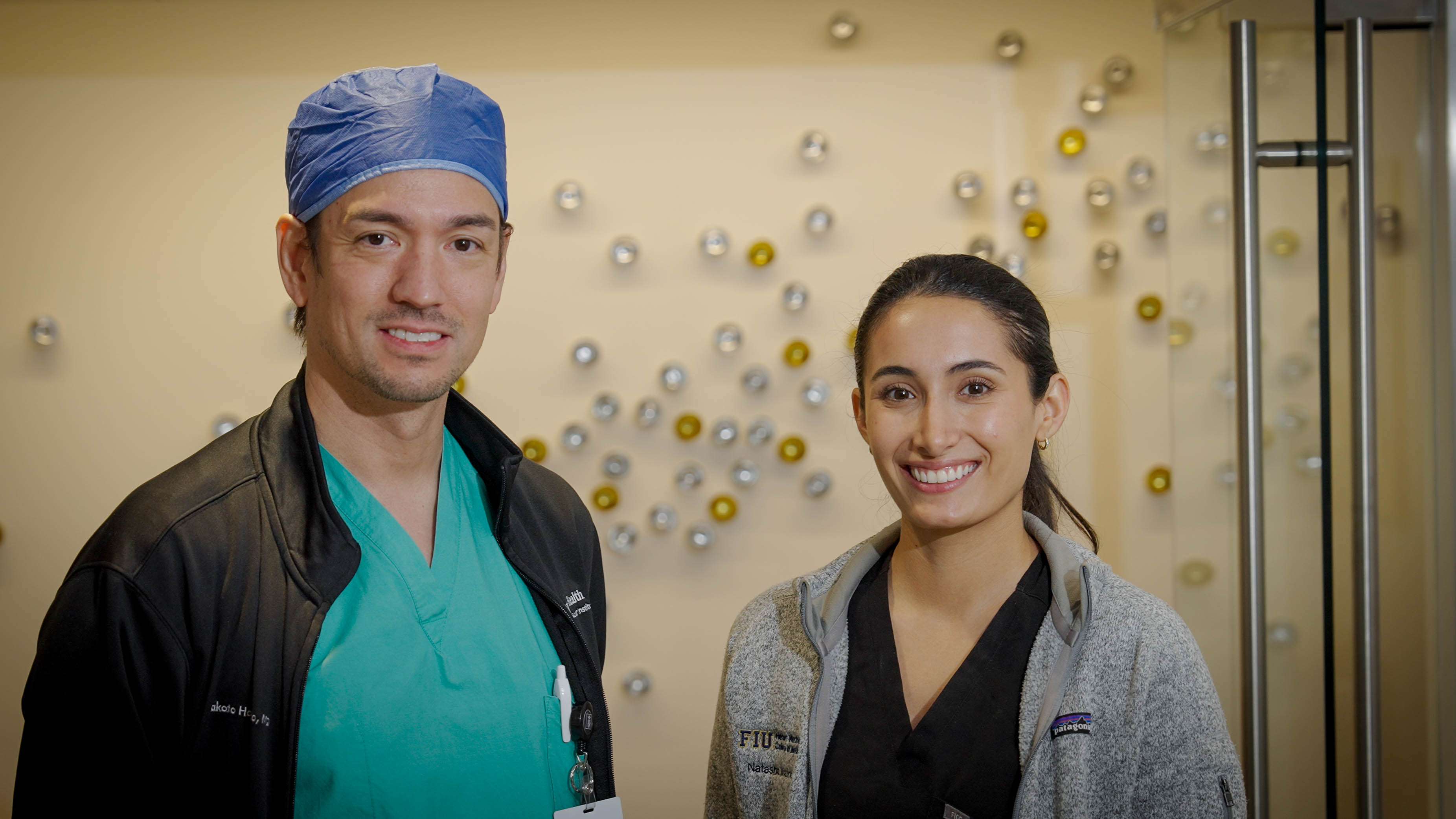 Dr. Hashimoto and Natasha Mazinani pose after the robotic procedure.

“From the moment the dean mentioned Dr. Hashimoto, it was one month until I was doing research with him, and in less than six months I was in the operating room with him,” Mazinani said.
As the dean recounted his experience in the operating room, she spoke about her interest in how robotic surgery was reshaping medicine. Cendan encouraged her to contact Hashimoto directly.
She followed his advice and introduced herself a few weeks later. By the end of that meeting, she had secured a mentorship. Soon after, Hashimoto brought her on as a research assistant.
By September, she was presenting their research to an audience that included the CEO of Baptist Health and FIU President Jeanette Nuñez. The work required her to absorb a highly technical field quickly — even tracking down translations of medical articles originally written in Japanese.
That November, less than six months after their first conversation, she was invited to observe Hashimoto perform robotic heart surgery.

Dr. Makoto Hashimoto performs more than 100 robotic heart surgeries each year. The surgery itself is complex, involving multiple physicians, nurses and technicians, along with an array of high-tech instruments that fill the room with a digital glow and the steady hum of machines.
After completing the opening phase of the operation, he transferred control of the robotic surgical system to Dr. Tom C. Nguyen, chair of FIU’s Department of Cardiovascular Sciences and chief medical executive of Baptist Health Heart & Vascular Care, director of minimally invasive surgery, and Barry T. Katzen Endowed Chair at Miami Cardiac and Vascular Institute.
From a position several feet away, Hashimoto narrated the intricacies of the procedure for medical student Natasha Mazinani at his side.
At one end of the operating room, Dr. Nguyen sat at a console resembling a cross between an arcade cabinet and an aircraft cockpit. Leaning forward, his face pressed into a binocular viewing screen while his hands guided two control grips with small, precise movements. His feet rested on pedals that transmitted additional commands to the machine, translating each motion into action inside the patient.
About 15 feet away, Hashimoto stood at a monitor, digital pen in hand, with Mazinani observing at his side. On the screen glowed a magnified, high-definition image of the inside of the patient’s heart. The patient lay on the operating table between them, surrounded by nurses, anesthesiologists and surgical technicians. From the patient’s side, several narrow instruments extended through small incisions, linking the body to the robotic system.
As the procedure unfolded, Hashimoto quietly explained key steps while keeping his focus on the screen. Mazinani leaned in, asking questions informed by months of research. He answered, keeping an eye on the moving image of the heart.
Hashimoto traced lines and marked points on the display, advising the procedure in real time. Those annotations appeared instantly in Nguyen’s view. Inside the illuminated chamber, tiny robotic arms responded. Their articulated pincers grasped a needle, passed thread through delicate tissue, pulled it tight, knotted and trimmed the suture.
The sequence repeated again and again, the patients Hashimoto and Nguyen working in unison until the procedure was complete — a choreography of human judgment and robotic precision performed deep inside the body.
“The integration of research, mentorship, and community immersion is not an add-on to our curriculum, it is foundational to how we prepare the next generation of physician leaders.” – Dr. Cendan
View this post on Instagram


Reflecting on his mentorship of Mazinani, Dr. Hashimoto said he sees supporting younger physicians as central to his role.
“The younger generation has a stronger passion for medicine than the older generation and I want to support that,” he said. “I try to show students everything I have learned and expose them to the real practice of medicine so they can decide what they want to do next.” Dr. Hashimoto’s mentorship is focused on helping medical students learn firsthand what medicine is in practice.
“It's so moving to see the difference between what I’ve learned in school and watch it apply in the real world,” Mazinani said. “To have Dr. Hashimoto next to me explaining what’s happening every step of the way is something I’ll remember forever, because one of my goals as a future physician is to work at the cutting edge of medicine with the latest technologies.”
For students like Mazinani, the school aims to pair rigorous scientific instruction with sustained faculty mentorship, giving students early exposure to advanced clinical environments.
“We’re very intentional about combining strong scientific training with real access to advanced clinical settings,” said Dr. Cendan, dean of FIU’s Herbert Wertheim College of Medicine. “Our students work side by side with accomplished faculty in some of the region’s most sophisticated health systems while also staying closely connected to the communities they serve through programs like the Green Family Foundation NeighborhoodHELP.”
