

Language disorders can make learning to read harder. Researchers are finding ways to help
Humans are hardwired for speaking. Learning to read doesn’t come quite so naturally. It requires retraining different networks in the brain.
Mastering such a complex skill is understandably a struggle for many children. Especially those with developmental language disorder (DLD). Affecting about 1 in 14 kindergartners, this lifelong, underdiagnosed condition makes understanding and using language difficult.
Speech-language pathologist Stacey Pavelko spent years helping children with language disorders in public schools. Today, she researches better ways to identify and support kids with DLD. In one study, a preschooler wrote their whole first name while a peer with DLD managed only the first letter — a glaring gap in phonological awareness, the letter-sound connection underpinning reading. The takeaway: simple writing tasks belong in intervention plans.
Now Pavelko is turning her findings into everyday tools for families. With a Wertheim Endowed Innovation Fund Award, she’s working with graduate students to create 3D-printed toys tailored to a child's specific needs. Each has a QR code linking to its own short video showing caregivers how play builds certain skills. One demonstrates how naming a toy's color ("Look at the red circle!") turns abstract language into something more concrete.
Next, she's offering free language screenings for preschoolers at FIU's Children's Creative Learning Center. Because “wait-and-see" approaches don't work. Children who aren't reading proficiently by third grade rarely catch up. The goal: reach them before that window closes.
“There’s very little time to teach children the literacy skills they need throughout their life, but with early intervention, we have a real opportunity to help a kid achieve all of their dreams."
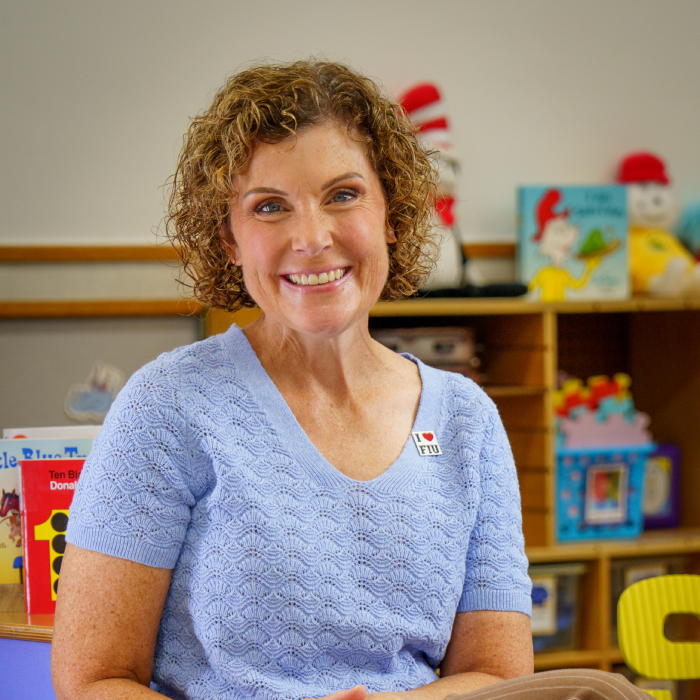
Stacey Pavelko
Associate Professor of Communication Sciences and Disorders,
Nicole Wertheim College of Nursing & Health Sciences