

Moving the needle on lung cancer screenings: FIU medical students work with researchers to improve outcomes
Lung cancer is the leading cause of cancer death in the United States, claiming more than 125,000 lives each year. There is a quick, painless screening test that can detect lung cancer before symptoms appear, when treatment is more effective. Yet more than 80% of those eligible for a low-dose CT scan (LDCT), never get screened.
It’s a problem that has driven students at FIU Herbert Wertheim College of Medicine (FIU Medicine) and faculty physician-researchers at Baptist Health Herbert Wertheim Cancer Institute to work together in their quest to improve lung cancer outcomes.
Their study, “Enhanced Lung Cancer Screening Through ‘Saved By the Scan’: Insights from a Multipronged Public Service Advertising Campaign,” was published in March in the medical journal BMC Public Health.
Meeting patients where they are
“We are missing many high-risk patients,” said co-first author and second-year medical student Logan Spiegelman. “Cultural competence is paramount. We must meet people where they are and not assume that everyone has the same healthcare literacy. That means providing educational materials in their language, assigning patient navigators to help them access care and raising awareness, even among healthcare providers.”
The study is unique in that it measured patient behavior by linking a bilingual, hybrid traditional-plus-digital advertising campaign to actual screening volume across 31 imaging locations throughout Baptist Health, the first local health system to partner with the American Lung Association for its Saved By the Scan program. Patients were reached through email, social media, newspaper advertising, direct mail, billboards, bus shelters and search advertising.
“The stakes of early detection are the whole argument for screening,” explained senior author Dr. Manmeet Ahluwalia, chief of medical oncology, chief scientific officer and deputy director, Wertheim Cancer Institute, and professor of Oncological Sciences at FIU Medicine. “When lung cancer is caught while still confined to the lung, five-year survival is roughly 60-65%, compared with under 10% once it has spread to distant sites.”
A Sharp Rise in Screenings
The results were striking. The study spanned 2019 through 2023, a period that included a pandemic-related decline in lung cancer screening in 2020. After the Saved by the Scan awareness campaign launched in late 2021, screening rates improved markedly. The number of annual screenings rose from 2,185 in 2021 to 3,285 in 2023, a 50% jump in just two years.
“We are making an impact,” Ahluwalia said. “The awareness gap is real and fixable. One study showed that 74.6% of Hispanic respondents believed that lung cancer could be prevented, but only 44.1% knew screening existed. Once informed, 90.7% wanted screening.” In an area that is 68% Hispanic and where nearly one in five residents is linguistically isolated from care, the need is particularly acute, he added.
Among the outreach methods, email performed best, likely because Baptist-registered patients who already had a documented smoking history were targeted.
A hands-on role for medical students
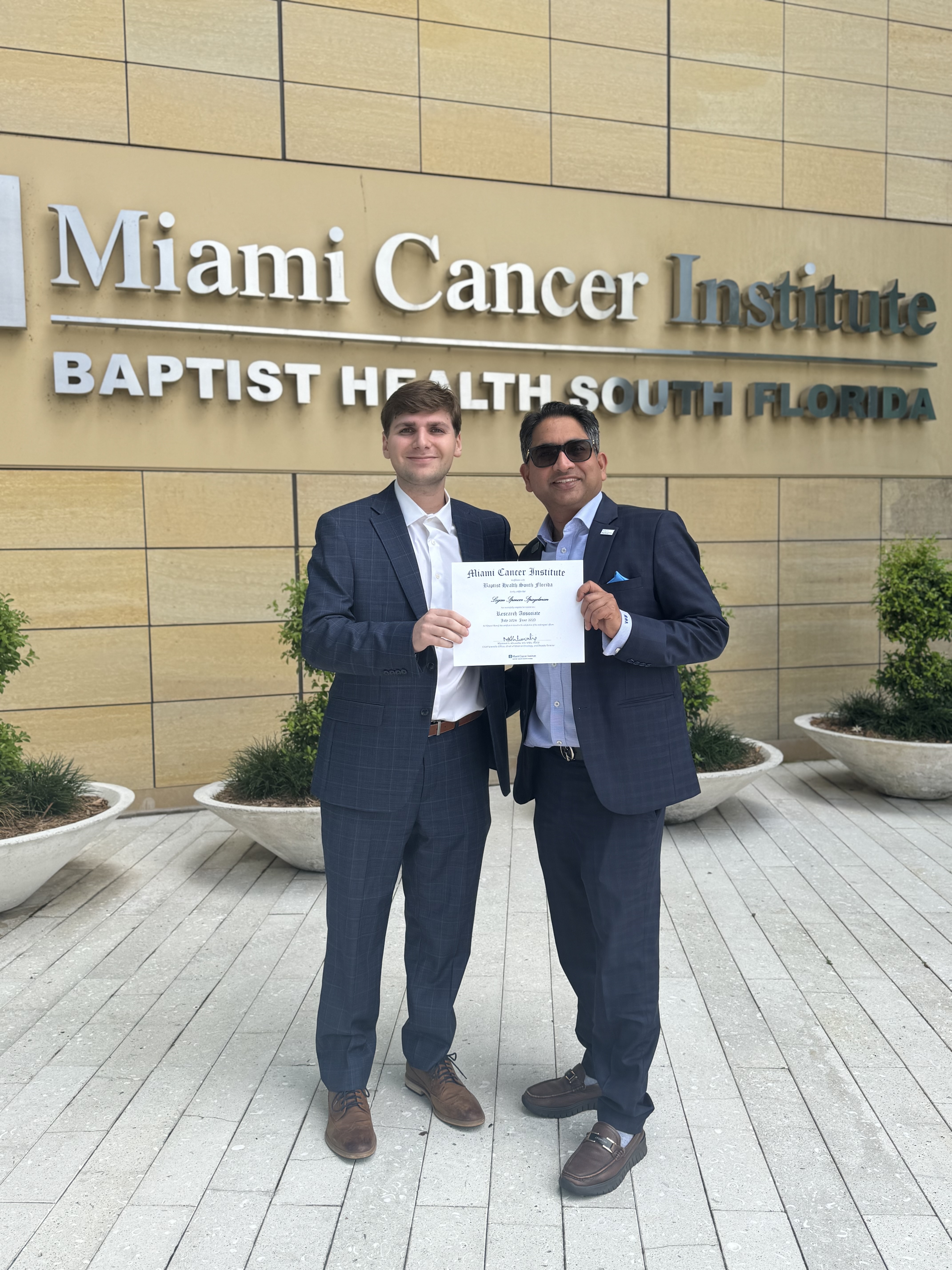
Spiegelman, who hopes to become a surgical oncologist, called the research project invaluable experience. His role included pulling and reconciling de-identified data, using specific software such as Tableau, along with building skills in study reporting and writing.
“Working with medical students is very gratifying,” Ahluwalia said. “The discipline they learn makes them better researchers and better readers of evidence. It also makes better physicians.”
For Spiegelman, the importance of the work really hit home when he reported for jury duty. “One of the other members of the jury pool told me their father was a lung cancer survivor and that he survived because his cancer had been caught through a screening,” he recalled. “I could actually see the fruit of our labor. It’s awesome for us and for them, as patients.”
While the team continues its work, refining outreach methods, better capturing smoking history and social factors that affect access to care and, addressing barriers such as referral patterns, insurance coverage, navigation and eligibility criteria, the message remains simple: screening saves lives.
Who should get screened for lung cancer?
You may be eligible for a low-dose CT screening if you:
- Are between 50 and 80 years old
- Have a significant history of smoking (equivalent to one pack a day for 20 years or two packs a day for 10 years)
- Currently smoke or have quit within the past 15 years