

Exploring the ocean depths: FIU scientists descend to world’s deepest hydrothermal vents
Nearly three miles beneath the Caribbean Sea, there is no sunlight. The pressure is crushing. And superheated, chemical-rich water pours from cracks in the seafloor.
Yet shrimp find their way there, by the millions.
How they do it is a mystery. FIU marine scientist Heather Bracken-Grissom recently returned from a month-long expedition in the Caribbean where she explored the deepest hydrothermal vents in the world. She was accompanied by FIU postdoctoral scientist Danielle DeLeo and graduate students Maureen Howard, Angel Rodriguez and Mary Williams from her lab and Haley Glasmann from FIU marine scientist Kevin Boswell’s lab. They joined an international team of scientists investigating how vent shrimp use vision and light to navigate one of the planet’s most extreme environments. The expedition aboard the research vessel Atlantis included dives in Alvin, the famed human-occupied submersible capable of carrying scientists thousands of meters beneath the ocean surface.
The team first explored vent fields along the mid-Atlantic ridge in 2025 before setting their sights on the Von Damm vent field along the Mid-Cayman Rise this summer. During both expeditions, they collected samples, environmental data and high-resolution images to help solve some of the mysteries surrounding these hard-to-study ecosystems.
On day 8 of the expedition, Bracken-Grissom and Daphne Cuvelier from the University of the Azores in Portugal embarked on a little detour, descending more than 5,000 meters aboard Alvin to explore the Beebe/Piccard hydrothermal vent field — the deepest known to humanity.
Alvin has achieved fame all on its own, enabling scientists to conduct deep sea exploration since the 1960s and most famously a detailed photographic survey and inspection of the RMS Titanic in 1986. Woods Hole Oceanographic Institution maintains and operates the submersible.
“Watching the Alvin team every day was my favorite part of the whole mission,” Glasmann said. “Alvin is so famous that when we were departing, local people were selling Alvin souvenirs, taking pictures and came out just to wave goodbye for the sendoff.”
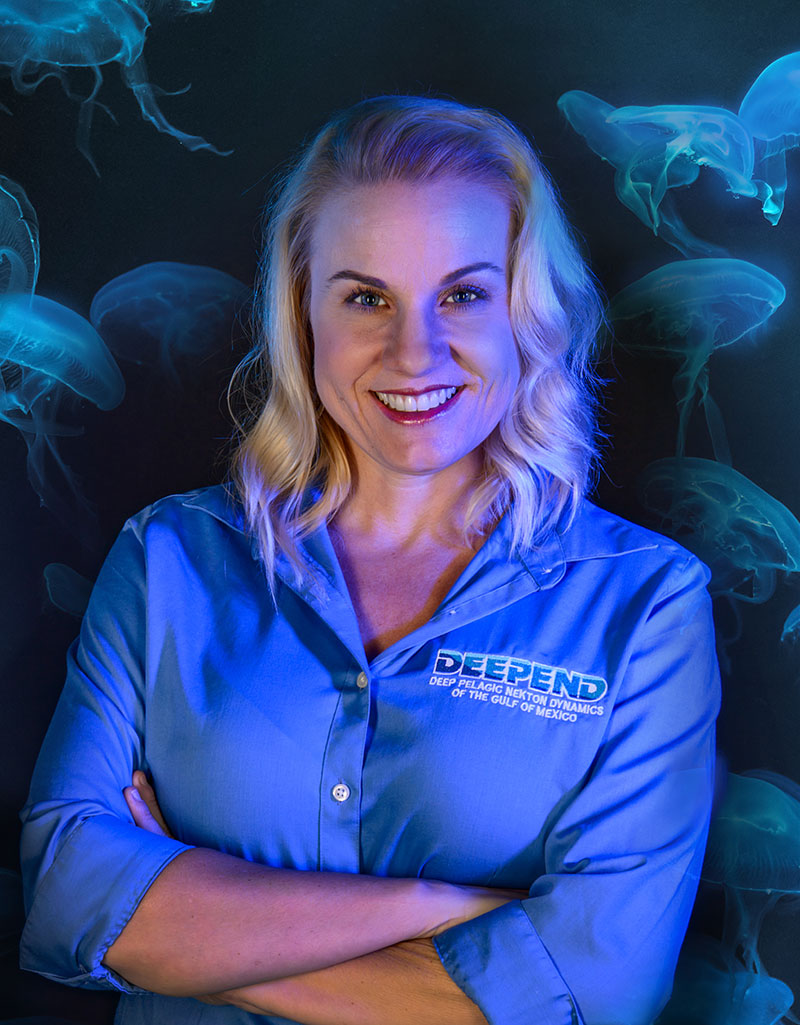
Heather Bracken-Grissom is a marine evolutionary biologist who was the first to identify an unknown species of "monster" larva, part of an international team that captured the first-ever video of giant squid in U.S. waters and has both a species of crab and shrimp named after her. She has dedicated her career to uncovering the mysteries of the ocean including the deep sea hydrothermal vents and the animals that call this extreme environment home.


Bracken-Grissom’s team is particularly interested in a strange feature found on some vent shrimp: a large light-sensitive organ on their backs known as a dorsal eye. Vent shrimp present scientists with an intriguing puzzle. They aren't always born at hydrothermal vents. As larvae, they can be found hundreds or even thousands of feet away. Eventually, however, they somehow locate the isolated vents where adults congregate.
What leads them there? Could it be light?
Scientists have proposed that the shrimp's unusual eyes may be sensitive enough to detect faint radiation produced by the extremely hot vents. Bracken-Grissom and her collaborators are also investigating another possibility — light produced by living organisms called bioluminescence. She said this could help the shrimp detect or navigate toward the vent ecosystem.
Finding out requires studying the animals under extraordinary conditions.
The team is examining the shrimp's visual sensitivity, genetics and eye structure while also using specialized low-light imaging to search the surrounding environment for potential sources of light.
Howard spent much of her time documenting the specimens collected during the research excursions including shrimps, sponges, brisingid sea stars, heteropods, corals, fish and even an unhatched dumbo octopus egg that was attached to one of the collected corals.
In addition to the FIU team, the research mission included teams led by Tamara Frank from NOVA Southeastern University, Jon Cohen from the University of Delaware and Sonke Johnsen from Duke University.
For Bracken-Grissom, who is the assistant director of Coastlines and Oceans in FIU’s Institute of Environment, the expedition is the latest chapter in years of work investigating how deep-sea animals live in darkness. Her research combines genetics with the study of vision and bioluminescence to understand how shrimp and other crustaceans survive in environments humans are just beginning to explore.
The answers could reach beyond understanding one unusual shrimp. These animals have evolved visual systems capable of functioning where virtually no light exists. Researchers say understanding how those systems work could eventually inspire technologies designed to detect extremely faint sources of light.
For now, though, the team is trying to answer a deceptively simple question:
In a vast ocean of darkness, how does a shrimp find its way home?