
FIU students develop device to detect early signs of preterm labor
Biomedical engineering doctoral students Jenny Pei and Amanda Sanchez developed a portable imaging device that uses polarized light to detect early signs of preterm labor risk— potentially identifying at-risk pregnancies up to three months earlier than current screening methods.
One year. That's how long doctoral students JunZhu (Jenny) Pei and Amanda Sanchez worked toward their goal of reaching the finals of the prestigious EF Hult Prize — the international competition that invites participants to build, scale and pitch innovations tackling global issues. Advancing from a field of roughly 18,000 contenders to earn a spot among the final eight teams, Pei and Sanchez faced one last challenge: presenting their idea on the world stage for a chance to win the $1 million dollar grand prize.
Wearing matching outfits before an audience of investors and venture capitalists, the dynamic duo addressed a panel of judges at the historic Ashridge House outside London. Countless hours of research, networking and late-night strategizing all boiled down to its core — a single, powerful message of innovation and hope.
Pei shifted her weight nervously and took a deep breath. Sanchez smiled and folded her hands, poised. The clock started. In four nailbiting minutes, the pair took turns describing a universal yet little-known problem: preterm labor. Then they offered their solution: a portable, handheld device that detects the earliest signs of this condition in just five seconds.

A growing epidemic
More than one in 10 babies worldwide is born prematurely (before 37 weeks of pregnancy). This rate is increasing. However, scant knowledge exists about preterm birth or why it occurs in the first place. While many babies born early go on to thrive, others suffer serious consequences. Sometimes, they do not survive.
Case in point: Every 40 seconds, a child dies from complications of preterm birth, totaling over 2,000 babies globally a day.
These sobering statistics amount to an incalculable cost: lives lost.
“It was kind of insane how many people came up to us during this journey and said, ‘Thank you for doing this,’” Pei says. “To meet people that we are trying to help, to see that we could have such a big impact on so many people who deal with this is exciting.”
Echoing her partner, Sanchez adds that the problem became more personal every time they met another person who experienced preterm birth.
While awareness has been growing, the pair initially met with many blank stares. Most people didn’t realize that preterm birth is a problem. Or one without a solution, Pei explains.
Current methods for detecting the risk of preterm labor betray blind spots. Digital exams are performed irregularly and remain too subjective, failing to identify 70% of at-risk babies. Biochemical tests, like fetal fibronectin (fFN), occur too late in the pregnancy. And ultrasounds reveal the length and width of the cervix but not necessarily the risk.
Pei and Sanchez, biomedical engineering doctoral students in the FIU College of Engineering & Computing, are racing to commercialize a device that can “see” what other methods cannot — and much earlier too.
“We can wave the red flag three months before current devices can identify risk,” Pei says.
The case for PPRIM
During a healthy pregnancy, the cervix keeps the baby securely in the uterus. Its strength and shape come from collagen that resembles the fibers of a rope. Gradually, these fibers loosen and become disorganized, softening the cervix to prepare for birth. If this process happens too early, it can lead to preterm labor.
The team’s device, called PPRIM (Portable Preterm Imaging), pairs patented hardware and software to detect those changes.
PPRIM shines polarized light onto the cervix and rapidly captures images to reveal how the collagen fibers are arranged. The team’s software then analyzes those images by visualizing them as a color-coded map that can be read in a glance. Cooler colors indicate higher organization of collagen fibers, and thus lower risk of preterm labor. Meanwhile, warmer colors signal more disorganization of these fibers and, therefore, higher risk.
More than one in 10 babies
worldwide is born prematurely (before 37 weeks of pregnancy).
Every 40 seconds
a child dies from complications of preterm birth

The birth of PPRIM
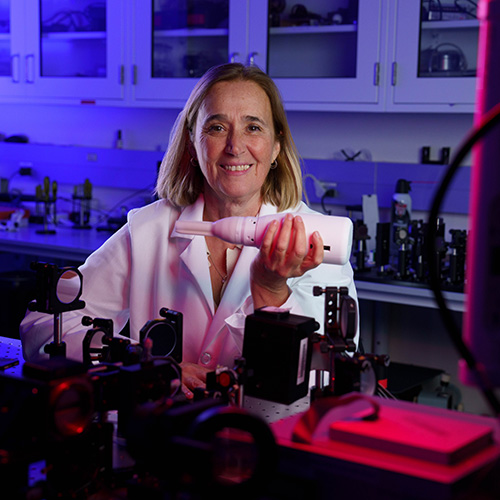
Jessica Ramella-Roman, an FIU professor of biomedical engineering who runs the Medical Photonics Lab, has been developing this device for over a decade.
“There aren’t many tools for seeing this invisible process and what we do have now is insufficient,” she says. “Women have given birth forever. I often wonder: How did we as women survive?”
Ramella-Roman’s colleague Amir Hossein Gandjbakhche, a National Institutes of Health (NIH) researcher, also works in the field of polarization imaging. He suspected cervical collagen changes during pregnancy.
But when trying to test this theory, he struggled to recruit pregnant volunteers. So, Gandjbakhche encouraged Ramella-Roman to conduct the study and lent her a colposcope, a bulky instrument employed by medical practitioners that uses bright light and magnifying lenses to examine the cervix.
Ramella-Roman took up the mantle. She attached polarization filters to a colposcope, essentially creating a modified Mueller Matrix polarimeter — an optical instrument that measures how a sample (in this case cervical tissue) changes the polarization state of light. This became the PPRIM prototype.
Ramella-Roman then recruited her longtime friend and colleague Nola Holness, a midwife and nurse practitioner in the FIU Nicole Wertheim College of Nursing & Health Sciences, along with now-retired physician Gene Burkett to run a pilot study at Jackson Health in Miami. The team compared 10 pregnant women in their third trimester who were at risk for preterm labor to a control group of female patients who were not pregnant. The results, published in the Journal of Biomedical Optics, showed changes in collagen during the third trimester (beginning at 28 weeks), thus corroborating these disorganized collagen fibers as reliable biomarkers for preterm labor risk.
“By looking at those biomarkers, you would know who you could send home, who you could observe, or who you would need to admit right away,” Holness says. “This would allow us to act faster, more decisively, and more efficiently.”
The study also demonstrated both the potential and shortcomings of the colposcope since its large size and the need for a speculum could be intimidating to some patients. Hoping to mitigate these issues, Ramella-Roman set about shrinking the design. After numerous iterations and a few patents, PPRIM evolved into a portable, handheld device.
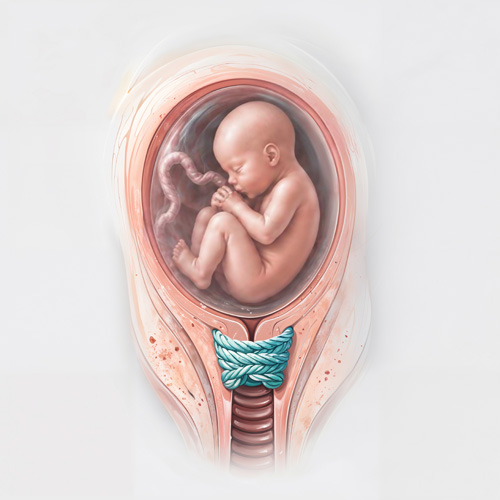
Cervical Remodeling Process
Throughout pregnancy, the cervix undergoes a gradual transformation known as cervical remodeling. The cervix remains long and closed for most of pregnancy, held together by a dense network of collagen fibers, many of which wrap around the cervical canal. Like the fibers of a rope, they give the cervix the strength to keep the baby secure, even as the tissue slowly begins to soften.
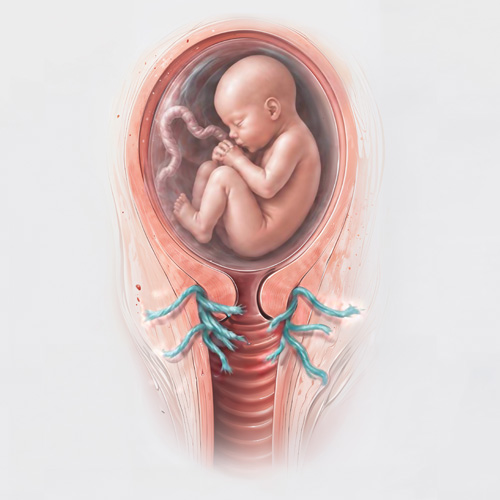
In the weeks before labor, remodeling accelerates. The collagen network loosens and becomes disorganized, allowing the cervix to soften further, shorten, and eventually open. When this process starts too early or moves too fast, it can lead to spontaneous preterm birth.
Team PolarDoc
Amidst the gadgets and gizmos scattered about the Medical Photonics Lab, Sanchez tinkers and examines the mechanisms of PPRIM. She’s responsible for optimizing the optics and instrumentation. A participant of the elite National Science Foundation (NSF) Science and Technology Center for Functional Imaging Summer Undergraduate Research (STROBE REU) program, Sanchez initially joined Ramella- Roman’s lab as a biomedical engineering undergraduate student. In 2024, she and Pei began working on PPRIM as graduate students, contributing to the group effort to develop the device.
Meanwhile, Pei, who received an NSF PATHS-UP fellowship, focuses on the development of their software’s algorithms used for risk detection and analysis. She spends a lot of her time in a lab, where she verifies PPRIM’s ability to identify biomarkers. With a few labmates, Pei completed an NSF Innovation Corps (NSF I-Corps) program, which prepares scientists and engineers to move their inventions beyond the university laboratory toward commercialization. Interviews with around 100 individuals including physicians, nurses, mothers, and insurers validated the demand for PPRIM.
We can develop the most beautiful devices, but if they’re not embraced by the medical community, they will not go anywhere,” Ramella-Roman explains. “Amanda and Jenny got a great response from pretty much everybody saying that this is something we really need.”
Ramella-Roman then suggested a novel avenue, albeit one outside their familiar territory: the Hult Prize competition.
The world stage
Beginning with on-campus qualifiers in Fall 2025, the PolarDoc team advanced through nationals, a six-week digital incubator, and then a month-long global accelerator to reach the last challenge. The final stages of the competition just so happened to take place at Ashridge House. At one point in time, the 700-year-old English castle operated as a World War II hospital. Around 2,700 babies were delivered in its maternity ward.
The arduous Hult Prize process catapulted Pei and Sanchez into an unfamiliar arena: the business world.
The duo had to develop new skills, including pitching, storytelling, scaling, and raising capital. The journey has been eye-opening for scientists who are accustomed to working in labs and publishing results in research papers.
“As scientists, we’re looking to solve a problem. But how our solution gets brought to people, that part we do not look at,” Sanchez explains. “There is a gap between bringing our solution to the right people and them bringing it to market.”
Learning the tools of the trade has not been without its growing pains.
Arriving at their campus office each day by 7 a.m. and working until 10 p.m., the team continually refined their business model, met with potential investors, and pitched non-stop, including to Google London executives. Each time, they received feedback that sent them back to the drawing board. Sometimes, that feedback could be brutal. On one occasion, their pitch deck was likened to a high school project.
“It’s intimidating to try new things, because you can fail,” Sanchez reflects. “And it’s not easy to hear criticism and keep going.”
Fortunately, the two women had each other to lean on for support. Through partnership, they endured and bonded as friends, recognizing each other’s strengths.
Naturally chatty, Pei is positively effusive about her more diffident partner’s growth throughout the competition. “Amanda was very scared of public speaking, but now when she gets up onstage, she is so cool and calm headed.”
Standing backstage before their final pitch, this dynamic was on display. Another team approached PolarDoc to wish them luck and gently suggest that Pei try not to cry onstage. “I can control myself,” Pei laughs.
Without missing a beat, Sanchez adds, “Jenny brings the emotion, because she’s very good at that,” celebrating her partner’s ability to connect authentically with audiences. This ability has distinguished the PolarDoc team as they have endeavored to bring an oftentimes fatal problem — and the science around it — to life.

After the applause
The winner was announced, and a party ensued. Pei and Sanchez boarded their 6 a.m. flight and returned home to Miami. Even though another team took home the grand prize, the two women achieved unprecedented international exposure by reaching the global finals, a first-time feat for an FIU team.
“Our goal was to be able to pitch in the final eight, get the message out there and raise awareness, and make connections,” Pei says with pride. “We did that.”
Pei and Sanchez are currently finishing their studies at FIU while continuing their pursuit of commercialization. After graduating, they plan to avail themselves of Hult International Business School’s offer to cover the cost of their MBAs. They know they have a lot more to learn about the business world. They also aren’t done with pitching. The duo plans to participate in more competitions and pursue additional partnerships.
In the meantime, they’re collaborating with Baptist Health South Florida, the largest healthcare organization in the region, to work toward a clinical trial involving pregnant women.
Obstetrician and gynecologist Dr. Larry Spiegelman will be helping to guide the two women in this effort. He is the Baptist Health Baptist Hospital Medical Director, Women’s Services and Graduate Medical Education and also a clinical assistant professor at the FIU Herbert Wertheim College of Medicine. Spiegelman believes PPRIM can be a valuable tool for physicians, like himself, by providing new diagnostic methods to prevent preterm birth and administer evidence-based care – care that can prolong a pregnancy, care that includes medications capable of decreasing the risk of lung and neurologic disease affecting some premature babies. With the data they gather from this future study, Pei and Sanchez can begin the lengthy, multi-step FDA regulation and approval process.
By maintaining their momentum, the PolarDoc partners are closer than ever to realizing their dream of bringing PPRIM to market. And hopefully one day into the homes of expectant mothers across the globe.
“We definitely have a strong product,” Pei says.
“And this is only the beginning,” Sanchez adds. “On to the next milestone.”