

FIU is shaping the future of space exploration
The fast-growing space economy is projected to surpass $1.8 trillion by 2035, and FIU is leading the way. From next-generation materials and antennas to space governance, FIU researchers are addressing some of the biggest challenges standing between today’s technology and tomorrow’s missions.

Space-Resilient Materials
Space is harsh — radiation and temperature swings can destroy a spacecraft. Engineers at FIU’s Cold Spray and Rapid Deposition Laboratory develop coatings and materials that shield spacecraft from such damage. Several FIU-patented technologies have already been tested on the International Space Station and at NASA facilities.
1-2
Millisieverts (MSV)
Amount of radiation in deep space per day. That's 100x-300x higher than on Earth.

Nano Tech
FIU integrates cutting-edge nanomaterials into sensors, optics and small satellites. These technologies boost the reliability of spacecraft electronics — and even wearable systems inside astronaut suits.
~0.3
Nanometers
Thickness of the 2D materials developed at FIU. A human hair is 80,000 - 100,000 nm thick.
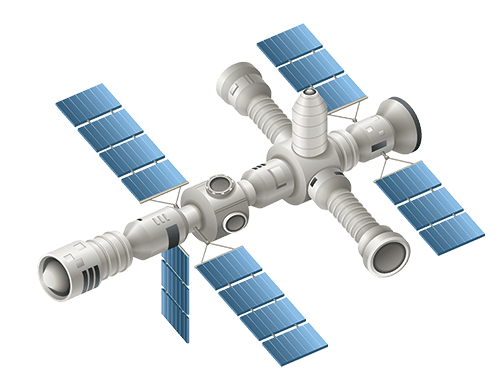
Space Power
Researchers are designing ultralight, highly efficient solar devices built from novel semiconductor nanoparticles. These materials could capture twice the power of today’s commercial solar tech, helping fuel future lunar habitats and long-duration missions.

Deep Space Communication
Researchers at FIU’s Transforming Antennas Center develop secure resilient communication systems capable of sending massive amounts of data across interplanetary distances — critical for real-time data for various industries, global internet and more.
30 - 100
Gigahertz (GHz)
Frequencies covered by several of FIU's antennas. Most smartphones operate at one to six GHz.
Space Governance
Jack D. Gordon Institute for Public Policy is leading research on space governance, security and policy, exploring not only how space technologies work, but how they’re managed, shared and regulated for the benefit of society.