

Student-led PolarDoc advances to Hult Prize Digital Incubator with device to predict preterm labor
The team wants to prevent preterm birth and win the "Nobel Prize for students"
This story has been updated from the original, first published in April, to reflect the students' continuing success in competition.
A trio of engineering students is a national finalist of the prestigious Hult Prize after winning FIU’s campus competition. The yearlong challenge – often dubbed the “Nobel Prize for students” – invites participants to build, scale and pitch innovations that tackle global issues.
Hoping to win $1 million in seed funding, graduate students Jenny Pei and Amanda Sanchez and undergraduate student Abiel Vasallo Veliz have worked on a project that addresses spontaneous preterm birth.
Preterm birth occurs when a woman goes into labor before 37 weeks and affects between 10% and 15% of all pregnancies. It is the number one cause of infant death. Even when not fatal, preterm delivery often results in severe consequences for the child due largely to underdeveloped organs.
Pei explains that little is known or understood about the cause of preterm births. Yet every two seconds, a child is born early, landing baby in a neonatal intensive care unit – an often emotionally and financially taxing experience for parents.
With the goal of improving preventive care, Pei, Sanchez and Vasallo are furthering the work of their mentor, Jessica Ramella-Roman. A biomedical engineer in the College of Engineering & Computing, Ramella-Roman runs the Medical Photonics Laboratory, where she and previous graduate students developed a patented, handheld imaging device called PPRIM (Portable Preterm Imaging).
The device works by taking rapid polarized images of the cervix – capturing how light interacts with human tissue – then relaying them through software for analysis. During pregnancy, collagen fibers naturally loosen and become disorganized to facilitate birth. The device visualizes this process of collagen realignment and structural changes in the cervix and acts as a diagnostic tool to assess the risk of preterm birth. (When high risk of preterm birth is identified, physicians can act to prolong the pregnancy through various interventions as well as prepare the fetus for early delivery by administering medication to accelerate lung maturation.)
Pei, Sanchez and Vasallo are actively contributing to the research and development of the device, says Ramella-Roman. She explains, “The Hult Prize is really their idea. They took the initiative to push [the innovation] further.”
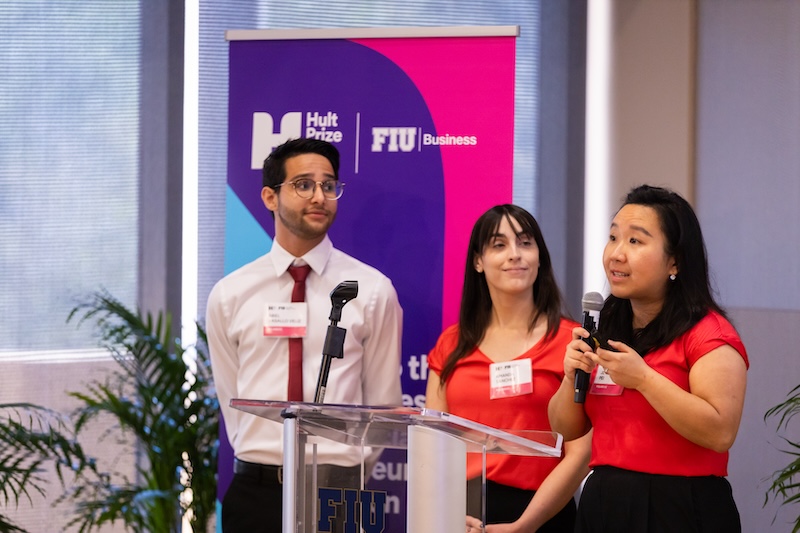
Each team member brings their own expertise to the table. Pei and Sanchez’s work forms a core aspect of their dissertations. Both are committed to optimizing the device, enhancing it to perform better.
Pei is primarily concerned with detecting “specific optical markers” or signs of premature remodeling, she explains, that typically signal when a woman is at risk of preterm labor. Meanwhile, Sanchez handles optical design and simulation, which, according to Ramella-Roman, includes algorithm-work and computer-modeling that ultimately can help predict early labor.
Senior Vasallo began working at the lab while enrolled in high school. His current research projects now focus on maternal health. A mechanical engineering major, Vasallo is responsible for improving upon the existing design with an eye toward future mass production of the device’s hardware.
Expressing a strong desire to work in industry, the team hopes to win Hult in efforts to take the steps needed to one day bring the device to market – beginning with physicians at hospitals, followed by clinics in underserved rural areas, eventually placing the device directly into the hands of women, thus enhancing access to medical care.
Winning this competition would lay a path toward such commercialization. “I think [the Hult Prize] will help us take our product to the next level,” Pei states.
Given advances in telehealth and the potential global reach of the device, Vasallo says, “I truly do believe that it is something that could revolutionize neonatal health.” The sentiment is shared by his teammates.
“If we do win, it’d be such a big move in the women’s health industry,” Sanchez says. “It would open everyone’s eyes to [the need to] invest in women and their future.”
In April, the PolarDoc team also won the startup pitch competition at Startup Olé in Miami. “Just days after being named Hult Prize Nationals finalists, this win is a reminder that the problem we’re solving, preterm birth, demands urgency, and that our team and our technology are ready to meet it,” the PolarDoc team said on LinkedIn.
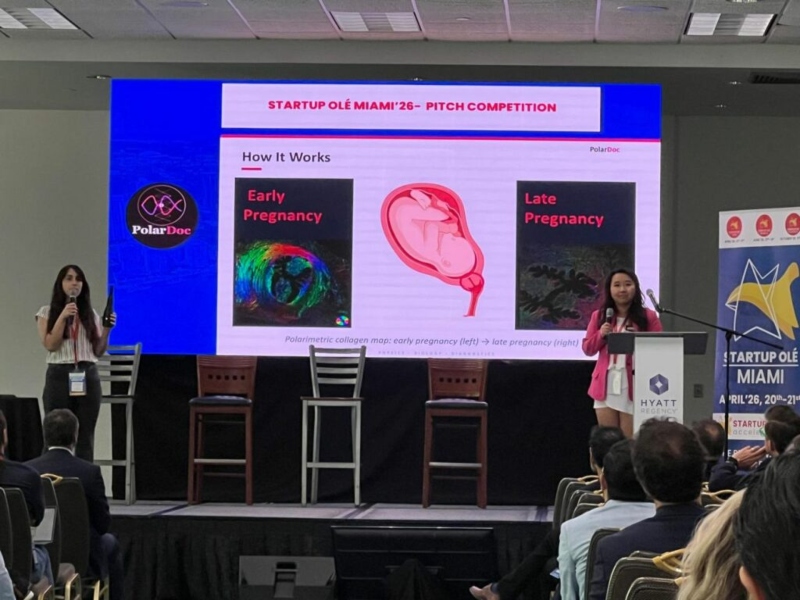
There are a couple more steps to the Hult competition before a grand prize winner is named. As a national finalist team moving forward with Pei and Sanchez, PolarDoc advances to the digital incubator stage in June and July, followed by the accelerator stage in August. From those, the finalists selected to pitch in the grand finale for the $1 million will do so in September.
As for Ramella-Roman, she feels her innovation is in good hands with the team. “They’re very good at what they do. I hope that they get out there and become an independent entity. They are creating their own jobs for the future.”
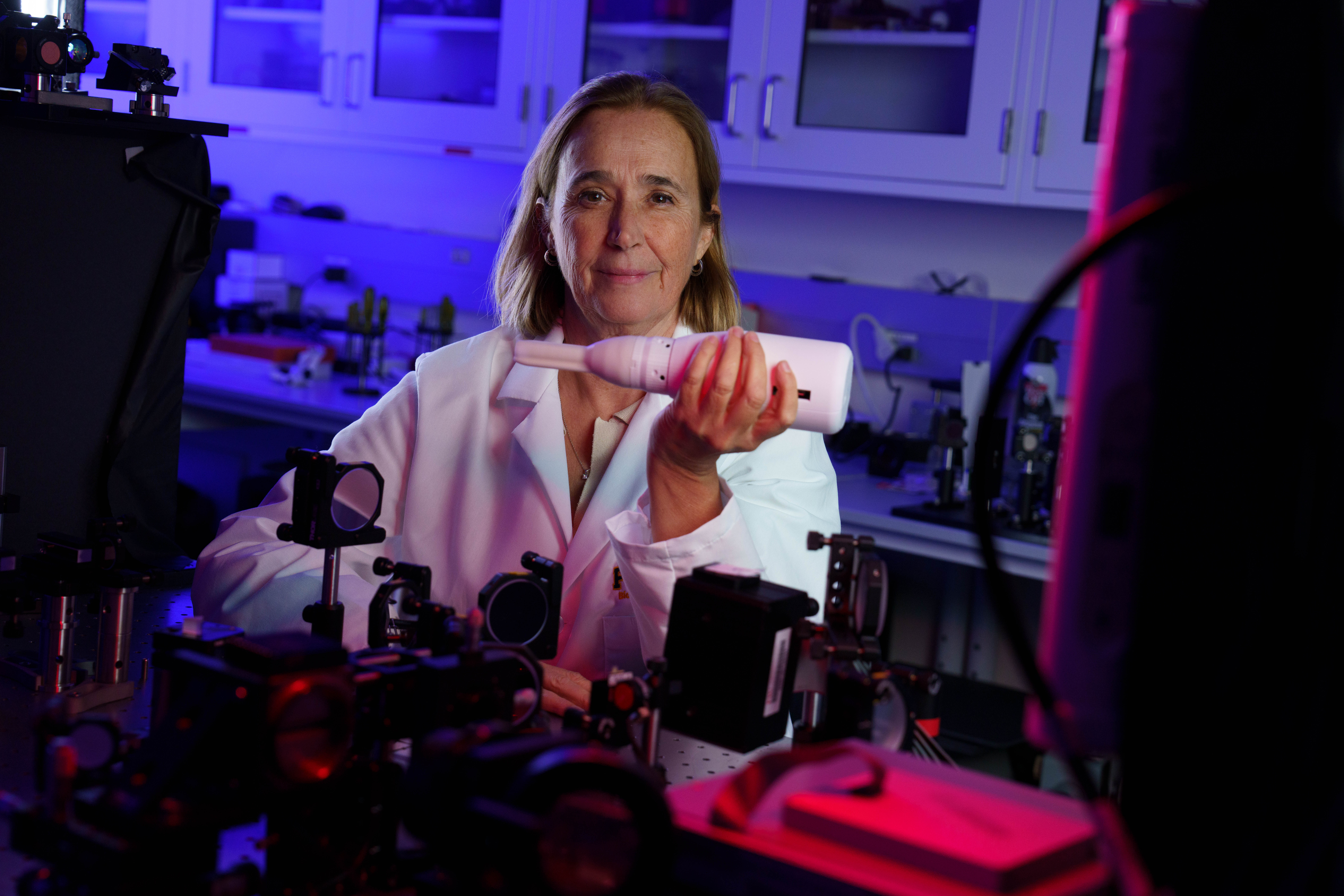
Professor of biomedical engineering Jessica Ramella-Roman with a model of her patented device to prevent preterm births, an innovation that several students are working to commercialize. Babies who are delivered early can experience a range of health problems due to immature organs, most commonly affecting breathing, feeding and temperature regulation. Serious short-term risks include respiratory distress syndrome, brain bleeds and intestinal infections. Long-term risks include cerebral palsy, developmental delays and chronic lung disease.