
South Florida's new home for extreme storm research
It’s a familiar dynamic we’ve seen play out across news organizations and social media platforms: A powerful storm makes landfall in a densely populated area of the United States. Full-scale disruption follows – to the built environment, natural systems, the rhythms of daily life. Lives are lost, families displaced. Communities and ecosystems are destabilized, sometimes irreversibly. The effects linger, shaping people and places for generations.
The Galveston Hurricane of 1900. The Great Miami Hurricane of 1926. The Labor Day Hurricane of 1935. Hurricane Andrew in 1992. Katrina. Ike. Sandy. Harvey. Maria. Irma. Ian. Helene. An infamous roll call, each name signaling a reckoning with vulnerability.
More than 125 years after the Galveston Hurricane killed an estimated 6,000-12,000 people in a single night making it the deadliest natural hazard-related disaster in U.S. history, the sequence of events surrounding extreme storms remains unsettlingly familiar. What is changing are the storms themselves. Weather patterns are intensifying; in some cases, storms are strengthening at unprecedented rates. Hazards are compounding. Wind, water and surge are converging in ways that increasingly strain existing infrastructure, ecosystems and emergency response systems.
If the risks are evolving, shouldn’t the way we study these storms evolve?
A team led by FIU of the nation’s top wind, wave and surge scientists and engineers thinks so. The goal: create a new scale of research that will shift the storyline of extreme storms from one of recurring disaster to one of informed resilience.
If the risks are evolving, shouldn't the way we study these storms evolve?

Resilience Science gets a Makeover
As stronger storms, rising costs and growing coastal populations reshape the nation’s understanding of risk, FIU is leading the most ambitious leap forward in resilience science in a generation.
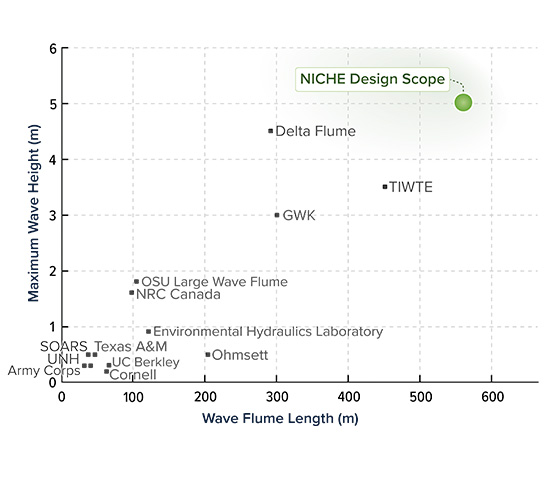
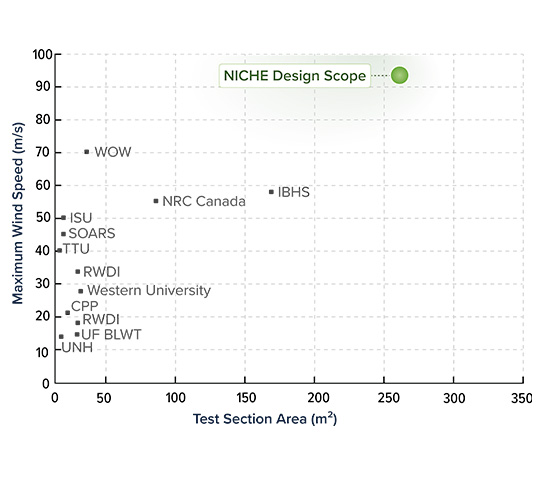
With a U.S. shoreline population of approximately 131 million people (39% of the population), natural hazards now inflict more than $100 billion in damages annually – impacting homes, economies, infrastructure and national security. Amid these realities, FIU is spearheading the creation of the National Full-Scale Testing Infrastructure for Community Hardening in Extreme Wind, Surge, and Wave Events – or NICHE – a groundbreaking facility that, when built, will redefine how researchers study the forces behind extreme events. With its design supported by funding from the National Science Foundation, NICHE would be the world’s largest testbed for exploring the combined effects of extreme wind, storm surge and waves on full-scale structures and coastal processes. For the first time, scientists and policymakers would be able to quantify natural and built infrastructure response under conditions that mirror the power of hurricanes.
“The envisioned NICHE responds directly to one of the biggest societally driven challenges of the 21st century, addressing the vexing impacts from natural hazards to ensure communities, infrastructure and natural environments continue to thrive,” says Arindham Chowdhury, principal investigator of NICHE.
NICHE is being designed as a full-scale facility to solve problems of scaling. Conventional testing, for example, may produce inaccurate results when scaling down a coastal low-rise building to investigate hazard impacts or miniaturizing sand particles to study beach erosion. This is because a wooden beam or a nail or a window cannot be scaled down properly to investigate damage under wind and water, explains Chowdhury, just as a sand particle cannot be scaled down without losing its inherent properties that govern particle transport.
Designed to produce 200 mph winds and 16-foot waves, the facility would allow experts to evaluate structural performance and coastal processes in ways no laboratory has done before. Its immersive physical-digital visualizations, including regional simulation tools, would enable stakeholders to step inside simulated storms to understand their impacts on communities while determining the efficacies of innovative solutions to impart resilience. They’ll be able to test mitigation strategies and even preview how proposed building-code reforms might perform when extreme weather strikes, making it a decision-making platform for communities, industry and government.
“NICHE’s combination of full-scale testing capabilities and a robust Artificial Intelligence component will be unmatched when built, really setting this facility apart,” says Jack Puleo, associate vice president for strategic initiatives in coastal engineering and resilience at FIU.
When built, the testing capabilities and impact of NICHE will be unrivaled anywhere in the world.
“We need unscaled capability so that we can attempt to solve engineering problems as they exist in reality. AI can be used as a predictive tool, but importantly, AI is data hungry. Predictions are only as good as the data being fed to the learning algorithms,” he continues. “Thus, the AI aspect will be iterative as new physical simulations are conducted, leading to improved and never-before-obtained observations/data.”
NICHE promises meaningful economic impact. Advancing hightech building materials, accelerating product commercialization, strengthening the nation’s resilient construction sector and innovating nature-based coastal protection, the facility would help position the United States as a global leader in disastermitigation technologies. Its insights could influence insurance models, reshape policy discussions and ultimately support safer, stronger and more prosperous coastal communities.

The NICHE Team
The $12.8 million National Science Foundation grant to design the world’s most powerful wind- wave-surge testing facility brings together the nation’s leading subject-area experts:
Wind
Arindam Chowdhury, Ph.D.
Amal Elawady, Ph.D.
Ioannis Zisis, Ph.D.
Florida International University
Kurtis Gurley, Ph.D.
University of Florida
Franklin Lombardo, Ph.D.
University of Illinois-Urbana Champaign
Paul Vasilescu
Aerolab
Surge
Jack A. Puleo, Ph.D.
Navid Tahvildari, Ph.D.
Florida International University
Herman Fritz, Ph.D.
Georgia Institute of Technology
Pedro Lomonaco, Ph.D.
Oregon State University
Computational Fluid Dynamics
Catherine Gorle, Ph.D.
Stanford University
Workforce Development & Stakeholder Engagement
John van de Lindt, Ph.D.
Colorado State University
Tracy Kijewski-Correa, Ph.D.
University of Notre Dame
Kristin Taylor, Ph.D.
Wayne State University