

Most predators slow down when ocean temperatures shift. Great hammerhead sharks don’t — not significantly anyway.
These ocean predators are masters of the "thermal hustle," maintaining peak hunting performance across a surprisingly wide range of ocean temperatures between winter and summer months, according to new FIU research published this week in Journal of Experimental Biology.
Like most ocean animals, great hammerheads have a peak performance water temperature. Theirs is about 84.7 degrees for swimming, hunting and maintaining their normal metabolic function. Like most animals, their performance declines as water temperature changes. However, unlike most other animals, their rate of decline is low. This means they can effectively hunt fast-moving prey like blacktip sharks in winter and fast-moving tarpon and barracuda in summer.
“This tells us that great hammerheads might tolerate changing climates better than other species,” said study co-author Yannis Papastamatiou, FIU associate professor of biological sciences and researcher in the Institute of Environment.
The scientists used advanced biologging technology to track movement, acceleration, depth and water temperature for nine hammerheads in the waters off Florida and the Bahamas. From this data, the team built the first "thermal performance curve,” showing how the sharks’ performance changes across temperatures. They then reviewed historical shark catch data and satellite tag records tracking where hammerheads swim. In spite of their thermal flexibility, great hammerheads were most often found in temperatures close to their preferred 84.7 degrees.
“As ocean temperatures change, hammerheads may shift their range to stay within temperatures where they perform best,” Papastamatiou said. “That could bring them into areas with heavier fishing pressure.”
Thermal performance curve is sometimes used to predict where species will move if oceans warm, but this latest research suggests temperature alone may not be a deciding factor for where great hammerheads are likely to go in the future. Great hammerhead sharks are among the ocean’s most formidable predators, capable of traveling thousands of miles. Yet, they have experienced drastic population declines in the past several decades and are listed as critically endangered by the International Union for Conservation of Nature.
The research was led by FIU alumna Erin Spencer and conducted in collaboration with researchers from Georgia Aquarium, Mote Marine Laboratory and other partners.
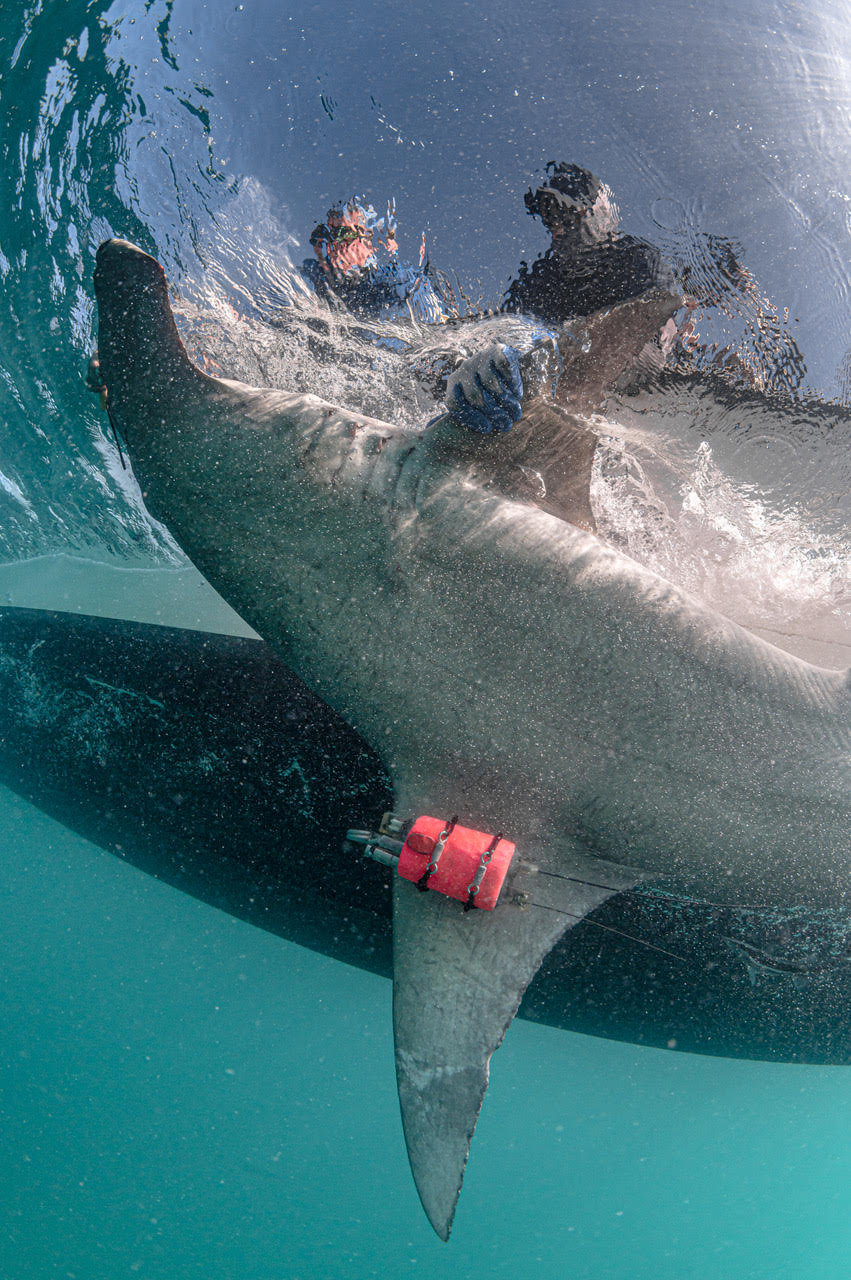
FIU researcher Yannis Papastamatiou tags a great hammerhead shark, captuing important data to advance knowledge about the iconic yet imperiled species. Photo by Fred Buyle.