
America’s reading skills are in decline. Nationally, about two-thirds of children aren’t reading at grade level.
Here, Stacey Pavelko — FIU associate professor of communication sciences and disorders in the Nicole Wertheim College of Nursing and Health Sciences —shares tips for parents who are wondering how to help nurture their preschoolers early literacy skills at home.
1. Start with their name
The single most motivating place to begin is your child's own name. It's usually the first thing children learn to write and, for a long time, their most advanced writing skill.
At first, children memorize their name as a picture. Then they pick up the first letter, and gradually they start connecting the letters they see to the sounds they hear. You can encourage this anywhere: have them “sign” a birthday card, label their own drawings, or write their name on a cup before a snack.
This is actually one of the first things Pavelko looks at when she assesses a young child in her research, because it reveals so much about where they are. In one of her studies, a typically developing preschooler wrote their whole first name while a peer with developmental language disorder managed only the first letter — an early gap in the letter-sound knowledge that underpins reading. Her takeaway: simple writing tasks like this belong in intervention plans, and in everyday family life.
2. Put a shopping list in the play kitchen
If your child has a toy kitchen or play area, add a small notepad and pencil so they can write down a "shopping list" before they "go to the store." Folding writing into pretend play makes it feel like fun rather than a lesson — and it teaches something powerful early on: that writing is a tool people use to get things done.
You can extend the idea to any kind of play. After all, a restaurant needs a menu and a doctor's office needs a chart.
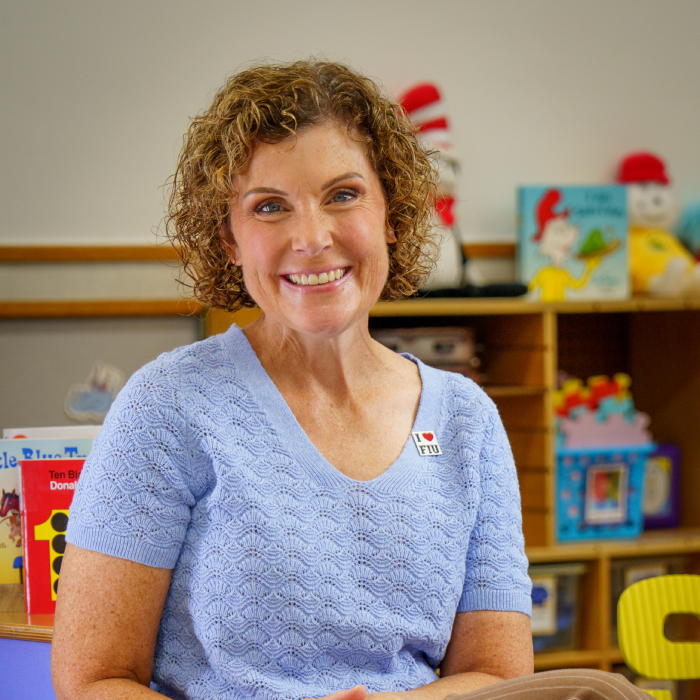
About the expert
Stacey Pavelko worked as a speech-language pathologist in public schools for years. Today, she researches how to better identify and support children who struggle to read. Most of her work is focused on developmental language disorder — a lifelong, underdiagnosed condition affecting about 1 in 14 kindergartners, that makes understanding and using language difficult makes understanding and using language difficult. Read more about her research.

3. Take it outside with sidewalk chalk
Writing doesn’t have to happen with pencil and paper at a table. Little whiteboards, old-fashioned chalkboards, and especially sidewalk chalk all count — and for many kids, they’re a lot more appealing.
4. Read together — but skip the pressure to read every word
Reading aloud is the classic advice, but Pavelko wants to lift the pressure that often comes with it. She says it isn't about the book — it's about the interactions you have around the book. You don't have to read every word on the page. Talk about the pictures, ask what might happen next, let your child turn the pages and set the pace.
Two things matter most:
Let them pick. If your child is obsessed with touchy-feely board books, lean in. Some research suggests a meaningful number of young children don't love books at first, so the goal early on is simply to build that affection.
Use the library. Many public libraries run free story times and programming, Pavelko notes — but the barrier is often awareness and access. Check whether your local branch offers sessions, then take your child to browse and pick their own books.
5. Practice, practice, practice
If your preschooler's class marches through a "letter of the week" starting with A, know that some experts are beginning to question that approach. Because not all letters are equally difficult. And different children already know different ones, Pavelko says, so a child might spend a week on a letter they mastered days ago while breezing past a genuinely tricky one.
At home, follow your child's lead and spend more time on the letters that actually give them trouble.
One useful benchmark: research suggests monolingual English-speaking children benefit from knowing roughly 18 uppercase and 15 lowercase letters heading into kindergarten.