

How environmental robotics is transforming coastal resilience
Ever heard of envirnmental robotics? This emerging field, advanced by researchers like Shahin Vassigh, uses robotic systems to monitor, collect data and analyze the performance and interactions of natural and built environments.
Through a project funded by the Environmental Protection Agency and supported by the FIU Institute of Environment, Vassigh and postdoctoral researcher Sara Pezeshk led an interdisciplinary team in developing innovative concrete tiles and blocks created for installation along Miami’s seawalls. These patterned designs bolster marine biodiversity and mitigate water pollution in coastal areas.
Some variations are equipped with sensors that capture water quality data, like salinity, oxygen and pH levels, temperature, as well as other vital data to monitor the health of important ecosystems like Biscayne Bay, which contributes $64 billion to the local economy.
Morningside Park, a neighborhood park in Miami with views of Miami’s Biscayne Bay, will pilot this innovative approach to coastal resilience. Vassigh also leads a team that has developed an AI-assisted learning platform for teaching industrial robotics in virtual reality. The NSF-funded project collects learner data to evaluate performance, provide feedback and personalize learning pathways, enabling more effective skill development and improved learning outcomes.
“AI opens up a new area of research, and robotics allows us to do materials exploration like never before. These technologies offer us new pathways to increase the resilience of the built environment. This is the future of construction, architecture education and resilience.”
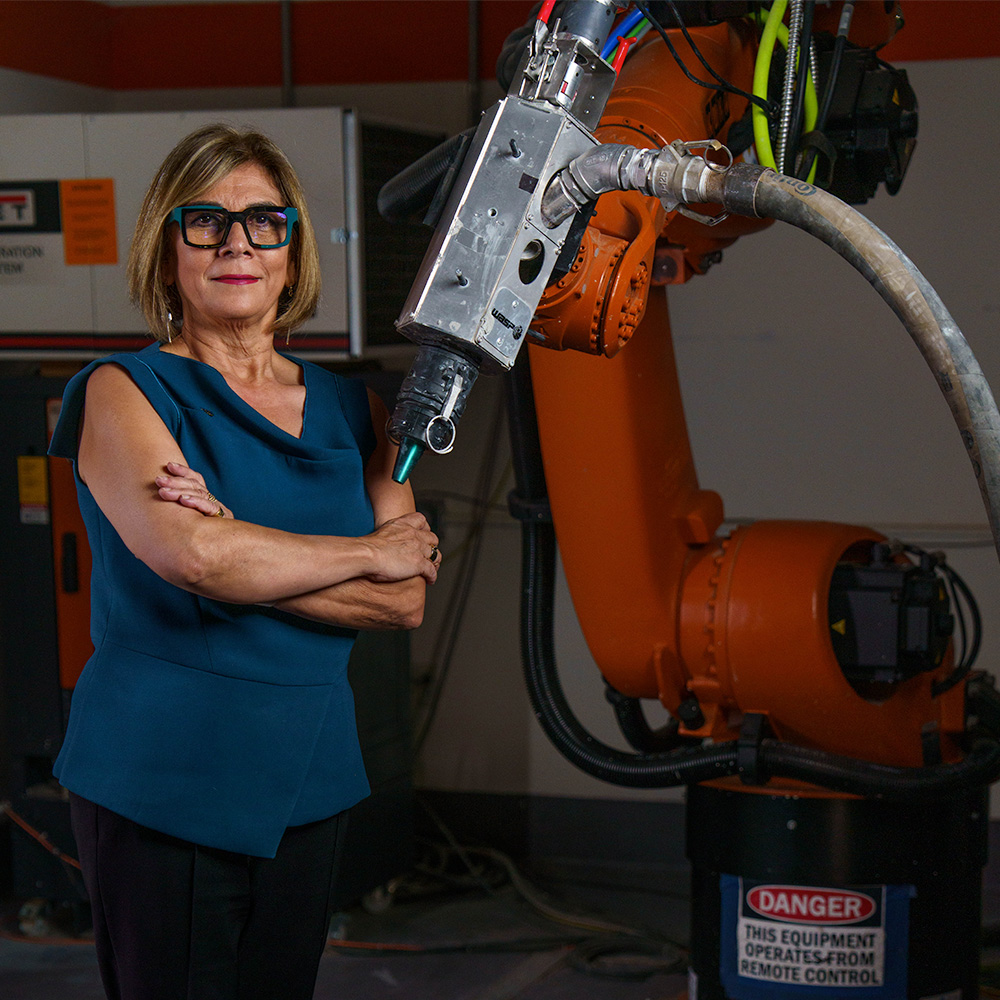
Shahin Vassigh
Professor of Architecture
College of Communication, Architecture + The Arts
Director, Robotics and Digital Fabrication Lab