

Higher education leaders discuss national trends at FIU
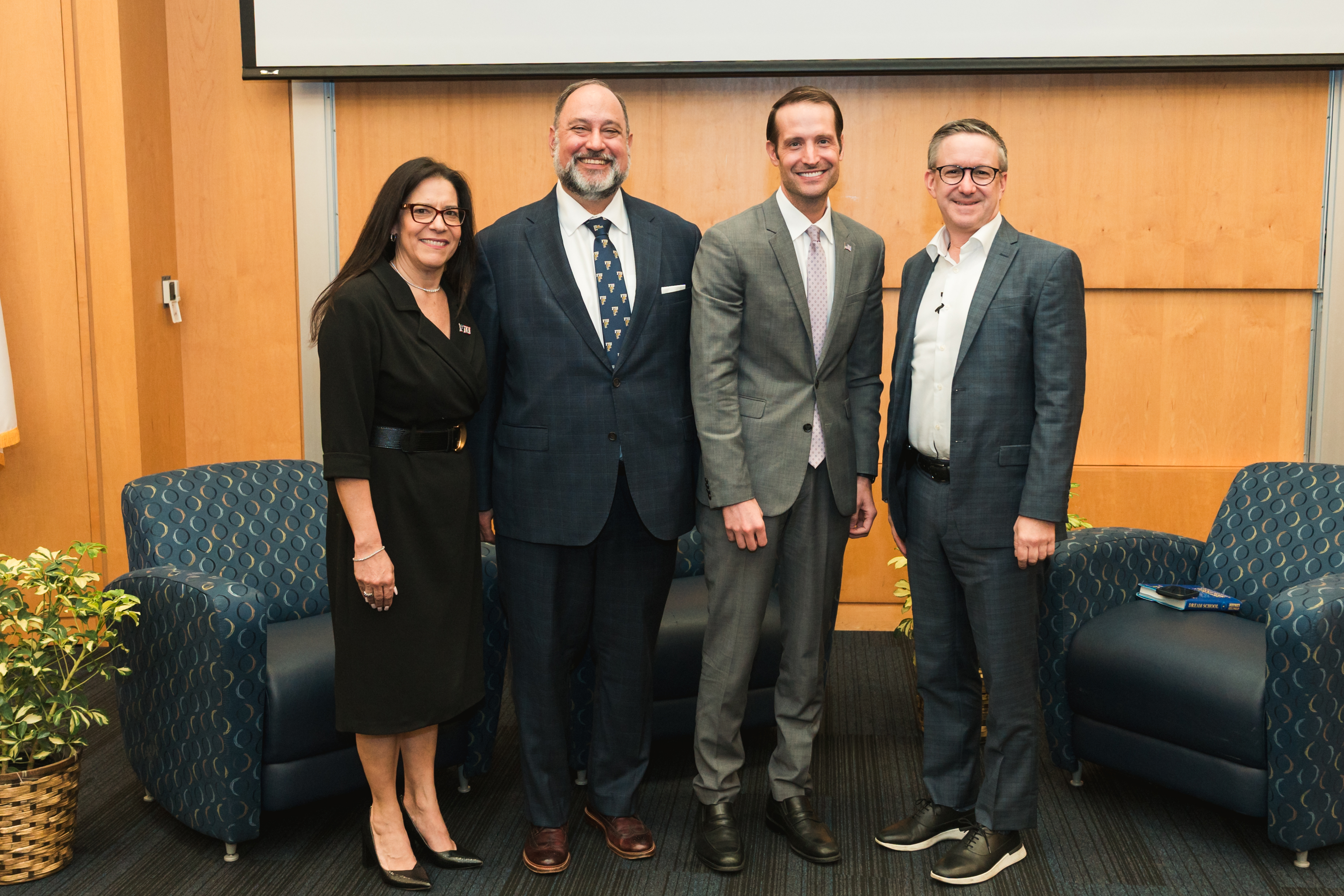
Under Secretary of Education Nicholas Kent, State University System of Florida Chancellor Ray Rodrigues and national higher education expert Jeff Selingo spoke about ROI and student success during a conversation on campus
The affordability of college. The value of a college degree. And the importance of training students to use AI ethically.
These are all topics that three of higher education’s leading voices discussed at an FIU event on Feb. 19.
U.S. Department of Education Under Secretary Nicholas Kent and State University System of Florida Chancellor Ray Rodrigues came to FIU on Feb. 19 to participate in the Horizon Summit, which was hosted by President Jeanette M. Nuñez and brought together higher education leaders, CEOs, entrepreneurs, Congressional leadership, senior federal officials and policy leaders.
National education expert and former editor of The Chronicle of Higher Education Jeff Selingo also participated in the Horizon Summit and visited the university the same day, spending time at FIU, which he named a Dream School in his recently published book, Dream School: Finding the College That’s Right for You.
As part of his day at FIU, Selingo led a presentation with FIU admissions team members, university communicators and education leaders, including college counselors, in which he discussed his book’s findings, the criteria he used to name the 75 Dream Schools listed in his book’s appendix and much more.
Kent and Rodrigues stopped by for an impromptu special portion of the presentation, in which they joined Selingo and answered questions about trends in higher education.
“It is my honor today not only to welcome Jeff to campus and to [have him] see the remarkable work in action but also to have a gathering of leaders at the state level and at the federal level,” said Provost, Executive Vice President and Chief Operating Officer Elizabeth M. Béjar. “United States Under Secretary of Education Nicholas Kent, thank you for joining us. And from our State University System, Ray Rodrigues. Thank you, Chancellor.”
ROI of a college degree
One of the key topics the leaders discussed: ROI.
“Florida does it [higher education] right,” Kent said. “But unfortunately, there are a lot of concerns in higher education across the nation. The value proposition of higher education is in question by students and families and taxpayers. And there are a variety of reasons for why that is. One is cost…One of the priorities that the Secretary and I spend a lot of time thinking about is, ‘How do we get the cost of higher education down in this country?’ It’s one of the primary topics that I talk about with college leaders around the nation.”
Kent also discussed the importance of higher education partnerships with the workforce and an upcoming federal initiative that aims to help support such partnerships. “Over the last few years, institutions and states really recognize that the partnership with the workforce is really critical,” Kent said. The idea: More workforce-institution partnerships will lead to higher student success outcomes and job placements — and increased ROI of a college degree.
Rodrigues discussed results of the highly regarded national survey of incoming freshmen conducted by the California Higher Education Research Institute at UCLA.
“What has been consistent for decades is the number one reason why students choose to go to college is because they want to get a better paying job,” Rodrigues said. “And then you ask those students ‘Do you anticipate graduating in four years or less?’ Nine out of 10 say ‘Yes.’ Higher education defines success as graduating in six years or less. So, on day one there is a fundamental break between what students and their families understand as success and what institutions understand as success. In Florida, we agreed to define success that would match.”
Florida has ranked No. 1 in the country for higher education by U.S. News & World Report since 2017. One of the reasons why?
“We measure our institutions on graduating in four years because if they feel like you’ve broken the promise from day one, then they’re not going to be happy at the end of the day,” Rodrigues said. “That’s been our focus in Florida. We ensure our degrees are [geared toward] the marketplace and we measure our institutional postgraduation results. Are students continuing education or are they getting jobs and are those jobs well-paying jobs?”
Student success & the American Dream
According to Selingo’s research, students and their parents don’t just want a prestigious name from their college — or an expensive tuition ticket as a telltale sign of quality.
What are they looking for? “Student success,” Selingo said. “Parents more than anything want their kids to go to college to find their people, to find mentors, to be in a community that wants to be there for them, a community that doesn’t allow them to be spectators to campus life. This is one of the reasons why FIU made it high on the [Dream Schools] list, because of the campus experience.”
"Parents want to know there is going to be experiential learning that will lead their kids to find their passion, a calling, a fulfilling career,” Selingo added. “They want to find places [colleges] where students are going to feel a sense of belonging and purpose around that.”
As evidenced by FIU's place on the Dream Schools list, the university is home to some of the most unique student experiential learning, including what many consider the largest experiential learning opportunity in the country: More than 1,500 students annually lead events, logistics and preparation for one of the biggest food festivals in the world — the South Beach Wine & Food Festival®.
In the end, Selingo said, he himself is proof that a college degree pays off. Selingo comes from humble beginnings: His grandparents worked for coal mining companies and garment factories in Pennsylvania; his dad was a music teacher; and his mom wasn’t able to go to college.
He and his siblings — now lawyers and doctors — did go to college. They found the right higher education institutions that helped them grow into the professionals they wanted to become.
“It changed my life and my siblings’ lives,” Selingo said. “I got to go to college. This is the story of the American Dream.”
Learn more about Selingo’s Dream Schools and his naming FIU to the coveted list.