

Kai Kopecky, University of Colorado Boulder and John Kominoski, Florida International University
People’s knee-jerk reaction to seeing death in nature is often not positive. The burn scar left by wildfire on a once-forested hillside, or a ghostly white coral reef, may evoke tragedy and despair. But in nature, most plants and animals are recycled back into new life.
The fallen branches and leaves that crunch under your boots as you step on the forest floor are providing nutrients for new growth as they decompose. Empty shells can become the foundations for new sea life to grow. Dead organic matter left over after a harvest supports soils and the production of food that feeds people worldwide.
These remnants of life can set both the pace and outcome of ecosystem recovery, enabling life to persist and thrive, or preventing it from doing so.
Ecologists, like us, refer to this as ecological memory, where remnants of the past influence how ecosystems look and behave in the present. Similar to human memories, traumatic events can have the strongest influences in nature: Fires, storms, heat waves and outbreaks of pests or disease can cause widespread death of plants and animals, leaving behind abundant and lasting physical remains.
In a new paper published in Science Advances, working with colleagues around the country, we show how death plays nuanced and powerful roles in nature’s afterlife.
In some cases, dead organisms prevent life from returning after an extreme event. In other cases, they make ecosystems more resilient by fueling regeneration of new life and hastening recovery. Understanding this afterlife and its influence on ecosystems will be increasingly valuable for helping ecosystems recover in a changing climate.
Foundation species – nature’s architects
Our study focused on a set of ecologically important organisms, known as foundation species. These are abundant and iconic organisms, such as trees, grasses, oysters and corals, that create the natural infrastructure on which entire communities of organisms exist.
Foundation species can be found everywhere, from the depths of the oceans to the summits of mountains. Because they are so abundant while alive, they can remain abundant after they die. And their influence can carry on in an afterlife that shapes the trajectories of ecosystems, either supporting recovery to the ecosystem’s original structure or transforming it into a new one.


To investigate how the dead remains of foundation species affect the ability of their living counterparts to establish, grow and survive, we tapped into a U.S. National Science Foundation network of Long Term Ecological Research. Scientists at these sites track populations of foundation species across a diversity of ecosystems that have experienced different extreme events.
We looked at coral reefs, mangrove forests, salt marshes, kelp forests, oyster reefs, tropical rainforests, temperate rainforests, hemlock forests, tallgrass prairies and boreal forests, ranging from the tropics to just shy of the Arctic Circle.
We found that, following extreme events, the dead affect the living more commonly than we expected. The dead foundation species either significantly increased or decreased living foundation species in nine out of the 10 ecosystems we studied – the kelp forest was the only exception.
In roughly half of the cases, dead foundation species hampered the ability of their living counterparts to reestablish, grow and survive after extreme events.
Take the tropical montane rainforest of Puerto Rico. This ecosystem is periodically walloped by hurricanes that strip its canopy and blanket the forest floor with tree branches and leaves. This layer of debris chokes off sunlight needed by the seedlings below and reduces the number that emerge to replace the trees lost during the storm, ultimately slowing the forest’s recovery.

The South Pacific coral reefs of Moorea present a more extreme example. Marine heat waves that cause coral bleaching can transform these reefs into something fundamentally different: ghost towns of dead skeletons overgrown by seaweeds. The nooks and crannies of the standing coral skeletons provide an opportunity for the seaweeds, which compete with coral for reef space, to proliferate and take over the reef, preventing the return of corals.
But in the other cases we studied, we found that dead organisms actually promote the regeneration of their living counterparts.
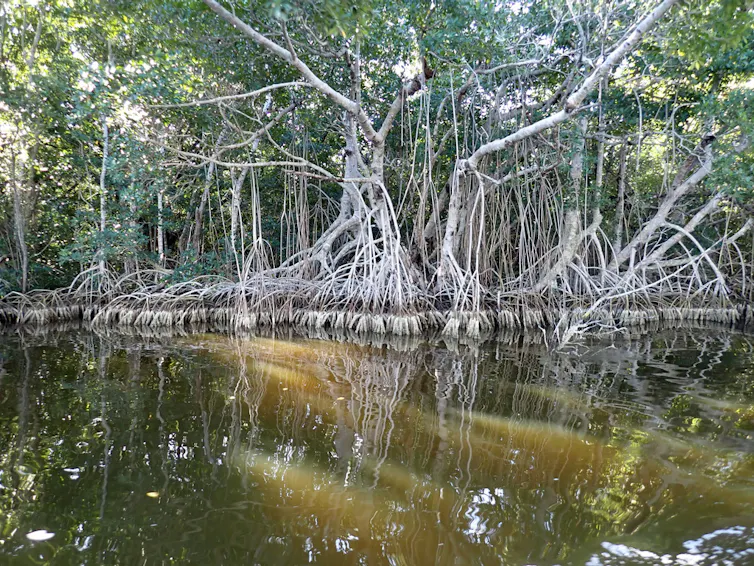
For example, the mangrove forests of the Florida Everglades actually benefit from storm-generated debris. During a hurricane, leaf litter blown or washed out of the canopy ended up in the complex network of roots below, providing a pulse of nutrients that enhanced the production of new roots and hastened mangrove recovery.
In the Eastern hemlock forests of New England, an outbreak of a tree-killing pest – the woolly adelgid – left behind wide swaths of standing dead trees. But unlike the dead skeletons on a bleached reef, these dead trees often help new hemlock saplings grow by maintaining a favorable climate on the ground below.
The question now is, how can humanity use this information to fortify the resilience of ecosystems after extreme events?
How humans can help
As humans, many of us rely on therapy to help manage how traumatic memories affect our lives. We can also help ecosystems manage the remnants of dead organisms after disasters in several ways.
On land, standing dead trees are sometimes felled to create “nurse logs,” which release nutrients that nourish living trees. Dead grass litter is removed using prescribed burning to create better conditions for new grass to grow. On the coasts, dead oyster shells are deposited onto mud flats, and the rubble of coral skeletons is either stabilized or removed to create more solid substrates where new oysters and corals can settle, grow and thrive.

As rising temperatures create more frequent extreme events and trigger more die-offs, dead foundation species will be useful to help guide ecosystem recoveries afterward.
Where there is life, there is death
When you’re in nature, whether hiking in a forest or snorkeling on a tropical reef, your attention is typically drawn to the life that exists in these places. But if you take a closer look, you may notice that death is all around, too.
Death is an integral part of life. The quicker we all learn to embrace its capacity to be a transformative force, and find ways to use the remnants left in its wake, the better we will be able to help nature and ourselves thrive into the future.
Kai Kopecky, Postdoctoral Researcher in Community Ecology, University of Colorado Boulder and John Kominoski, Professor of Ecology, Florida International University