

For more than 40 years, scientists believed the Miami palmetto palm had disappeared from the wild — until FIU Ph.D. candidate Daniel Tucker helped prove it was still there.
Tucker is uncovering the genetic secrets of the Sabal miamiensis to give conservationists new tools to protect it. His research is supported by the Catherine H. Beattie Fellowship in Conservation Horticulture, which promotes the preservation of endangered plants in the southeastern United States and is funded by the Garden Club of America and the Center for Plant Conservation. This palm species is considered critically endangered in its native habitat due to habitat destruction.
Tucker began by following the evidence alongside Larry Noblick, palm biologist emeritus with Montgomery Botanical Center, and Tim Joyner, preserve manager with Miami-Dade County’s Department of Regulatory and Economic Resources. The evidence led them to a small preserve in Miami-Dade surrounded by urban development. There, they discovered about 40 individual wild plants that looked like they could be the lost palm. The team examined the surrounding habitat and soil conditions and consulted scientific literature to confirm their findings, and a year later discovered another 60 of the palms nearby.
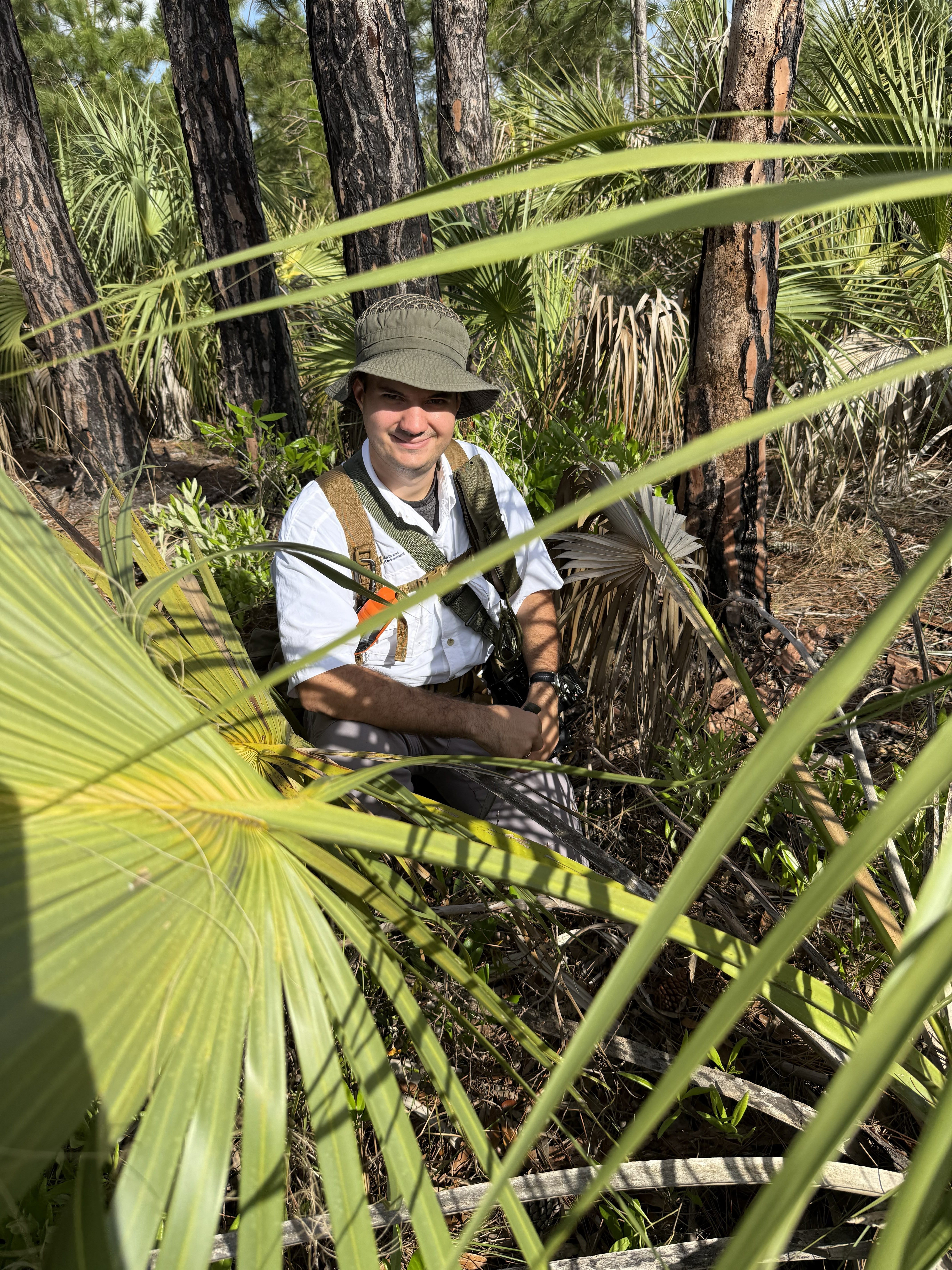
(Photo courtesy of Daniel Tucker)
“It was an incredible moment because it's a lot of emotions all at once,” Tucker said. “You know that now there's hope. You have something in front of you that you know you can work with.”
With support from the fellowship, Tucker is now building a reference genome that will provide a genetic baseline template for scientists. By mapping this DNA, Tucker can identify the most optimal breeding pairs, allowing the team to clone and cryopreserve individuals for the future.
“If we didn't have genomic resources, we'd be flying blind for a lot of these things,” he said. “Everything that we do is moving towards conservation.”
The Miami palmetto, which once existed in Miami-Dade County’s pine rocklands and along the Atlantic Coastal Ridge up to about Boca Raton, lost most of its habitat to rapid urbanization and development.
The rescued palms, along with mature plants collected in the '80s and '90s, are currently being cared for at Montgomery Botanical Center to help conserve the lineage. The team has identified a few suitable locations for reintroduction in partnership with Miami-Dade County Environmentally Endangered Lands Program. They expect to reintroduce about 50 individual plants in the wild by early next year.
As a safeguard, seeds and young plants have also been donated to other botanical gardens for conservation.
“No one garden can do everything,” Tucker said. “By joining together, we can do a decent job of conserving that biodiversity.”
A species once thought to be extinct in the wild now has a fighting chance in its original Miami home due to a mix of instinct and modern genomics. Tucker plans to continue the conservation program while studying the evolution of the Sabal species.
Tucker is a Ph.D. candidate in Earth Systems Science at FIU in the Conservation & Sustainable Horticulture Lab and a Montgomery Botanical Graduate Fellow at Montgomery Botanical Center.